GLD Racing Debuts Form Guides For Seoul & Busan
Starting this weekend, GLD Racing is officially live with full past performances, sectional pace indicators, and our signature speed ratings for South Korea.
If you are an American dirt handicapper or an international racing fan looking for high-conviction plays when domestic tracks are all wrapped up, here is why Korean racing could be your new frontier in thoroughbred wagering.
1. Deep Sand & Violent Kickback: Playing Angles
The first thing our model identified when we were training it on 10,000+ races is how the deep sand racing surface impacts late pace dynamics.
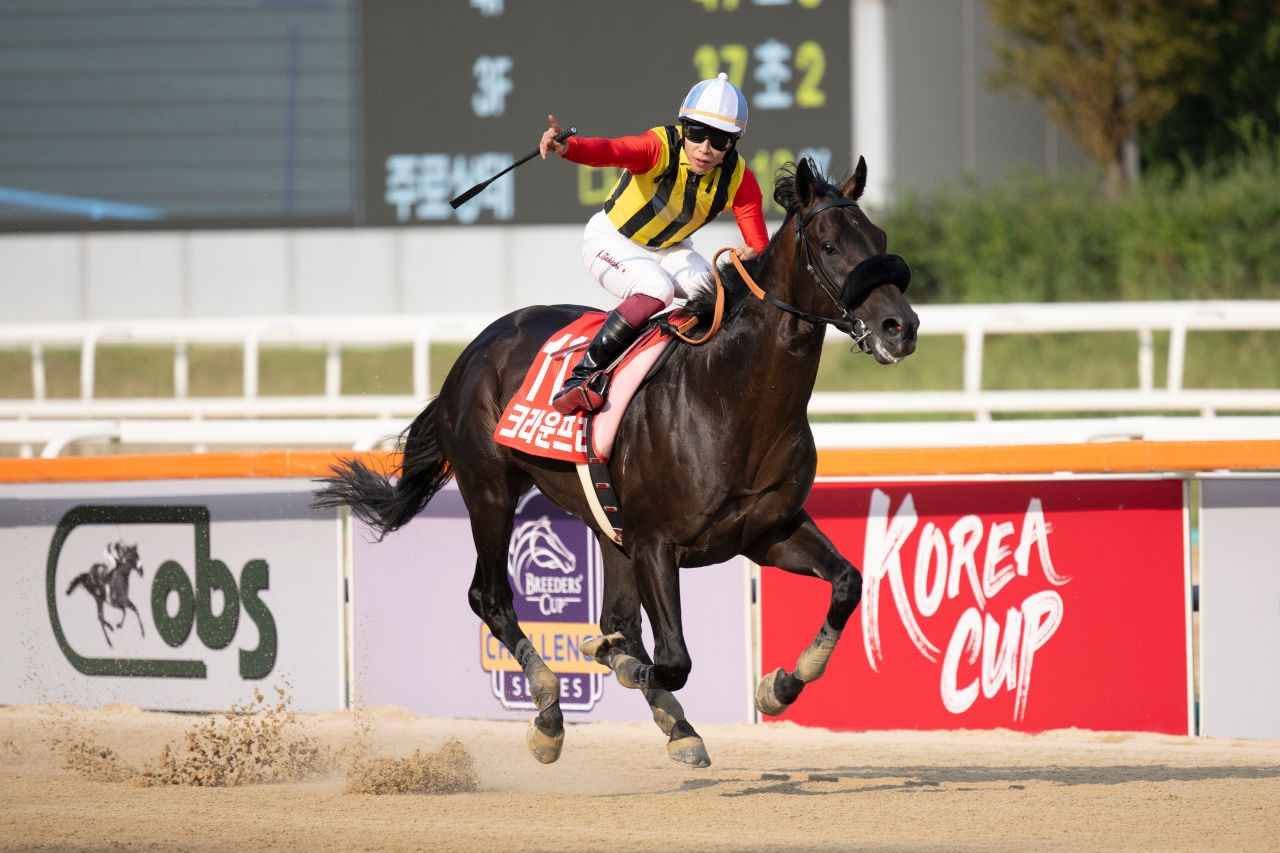
Every race at Seoul and Busan is run over deep, coarse sea sand with a cushion depth of 7 to 8 centimeters (roughly 3 inches). If you’ve ever sprinted through dry, loose sand at the beach, you know the feeling. Sand saps stamina, pulls at fetlocks, and creates an abrasive wall of kickback for horses trailing the leaders.
In turf racing, a horse can draft comfortably at the rear of the pack, save ground on the rail, and unleash a blazing final split down the straight.
On Korean sand, trailing horses eat flying sand with every stride. That physical deterrence creates a massive change in how our numbers weigh the dozens of factors we take into account when making projections. The GLD Racing engine for South Korea has been fine-tuned and tested exhaustively to ensure we’re providing players with our absolute best.
Disclaimer: Let's Run Park Yeongcheon opened September 13, 2026 and as of today (October 1, 2026) we are still building up historical race data for this course.
2. The Moisture Secret (함수율 - Ham-su-yul)
Because Korean racing is contested on sand, track conditions do not follow the traditional "Fast / Good / Muddy" classifications you find in North America.
Instead, the Korea Racing Authority (KRA) officially tests and broadcasts the precise sand moisture percentage (함수율) before every meeting. Understanding this number can be key to understanding how a race will play out:
- 1% to 5% Moisture (Dry / 건조): This is deep, shifting, beach sand. The track is heavy and slow. Early speedsters frequently burn out on the lead, and horses with late closing kick and stamina can grind down exhausted front-runners.
- 6% to 9% Moisture (Standard / 양호): Balanced racing where class and pace shape prevail.
- 10% to 14% Moisture (Wet / Damp / 다습): Traction increases dramatically, and winning times drop by nearly a full second.
- 15% to 20%+ Moisture (Muddy / Sloppy / 포수·불량): The track transforms into hard-packed wet shoreline. The surface becomes a lightning-fast speed strip. Kickback becomes heavy, sticky mud clods, making passing a tall task for a lesser horse. Early front speed dominates, and inside rail runners wire races at extraordinary rates.
When GLD Racing produces each new racecard, we grab the latest data available to us and update the condition of the surface within an hour of post time. Utilize our speed figures and pace maps early in your handicapping, and check back in closer to first post to narrow down your choices based on how the track is expected to play. Likewise, we will update our figures as post time approaches to make sure we’re finding the right angles and runners for you to focus your handicapping efforts.
3. GLD Speed Figures on Sand: The Great Equalizer
Raw finishing times in any horse race are notoriously deceptive.
This is where GLD Speed Figures act as your secret weapon. Our quantitative figures normalize every performance for distance, class par standards, and daily track moisture variants. We strip away the environmental noise and answer the only question that matters:
"If every horse in this race competed on a neutral track at today's distance, who is genuinely the fastest?"
Whether a horse is stepping up from Class 5 into Class 4 or returning from a six-month layoff, our speed figures let you compare horses across dates, tracks, and track moisture conditions with total confidence.
4. The Sectional Blueprint: S1F to 4C
Unlike traditional forms that only give you quarter-mile splits, our Korean past performances break down the crucial milestones of every race:
- S1F (Start to 1 Furlong): The initial 200-meter gate acceleration. In sprints (1000m to 1400m), the horse that wins the S1F battle almost always controls the race.
- 1C, 2C, 3C, 4C Sequential Calls: Position turning for home (4C) is a critical inflection point on sand. Historical modeling across 10,000+ Korean starts shows that horses positioned in the top 3 turning for home win at nearly three times the rate of deeper runners.
- G3F (Goal to 3 Furlongs): The final 600-meter closing sprint, measuring stamina reserves under pressure.
5. Dual-Layer Form: Fast Form vs Full Past Performances
Handicapping shouldn't require three hours of deciphering just to make an informed decision.
On GLD Racing, you have complete control over how you digest the card:
- Fast Form: Designed for a 30-second read on your smartphone. Instantly view top contenders, GLD Speed Figure badges, pace shape setups (Lone Leader, Presser, Closer), and our projected public market odds (GLD Line).
- Full Past Performances: Complete historical depth including sectional split times, apprentice claim allowances (-1 kg to -4 kg), weight shifts, and full running lines.
6. How to Get Started This Weekend
Korean racing action takes place nearly every weekend with this weekend scheduled as follows:
- Friday: Busan (10:15PM ET)
- Saturday: Seoul (9:35PM ET) & Busan
- Sunday: Seoul & Busan
The full interactive racecard for this weekend’s Korean fixtures is live right now on GLD Racing. Whether you’re looking to play single-race value overlays or dive deep into the full past performances, we’ve built the tools to help you find the edge.
Disclaimer: GLD Racing is an independent analytical service and is not affiliated with or endorsed by the Korea Racing Authority (KRA) or The Hong Kong Jockey Club. GLD Racing past performances and GLD Speed Figures are intended for educational and analytical purposes. We do not guarantee wagering outcomes. Please gamble responsibly. 18+.