GLD Racing Handicapping Guide
Learn how to interpret our proprietary speed figures, class benchmarks, pace segments, and equipment settings to find a premium edge at the racetrack.
Empirical Quantitative Masterclass • GLD Class Par (865,435 Starts)Core Quantitative Methodology Pillar Guides
Deep-dive institutional blueprints explaining how GLD Speed Figures, Par GLD vs. Race Power (RP), First-Turn Pace Maps (EP/LP), and the GLD Line work across JRA, HKJC, KRA, and NAR.
Pillar Guide 112 min read
Discover how GLD Speed Figures transform deceptive raw final times into standardized athletic ratings across 865,435 historical starts spanning Japan (JRA & NAR), Hong Kong (Sha Tin & Happy Valley), and South Korea (Seoul & Busan) using inter-quartile track variants, surface moisture curves, and beaten-length physics.
Pillar Guide 213 min read
Learn how to separate official race conditions from true competitive field quality by comparing static GLD Class Par Par GLD benchmarks against dynamic Race Power (RP) across JRA (Newcomer to G1), HKJC (Class 5 to Class 1), KRA (Class 6 to Class 1), and NAR (C3 to A1).
Pillar Guide 312 min read
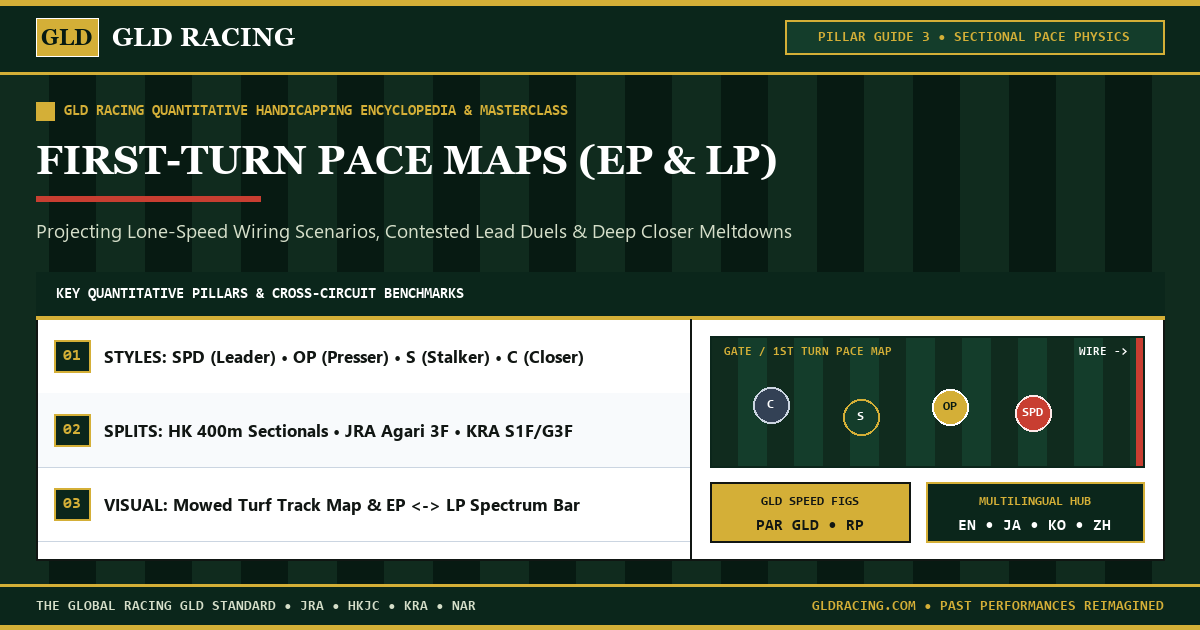
Master the physics of horse racing pace projection. Learn how GLD Racing normalizes Early Pace (EP), Late Pace (LP), Pace Differential (PD), closing 600m sectionals (Agari 3F, G3F, and HK 400m S1-S6 splits), and SPD/OP/PCK/C running styles to spot lone-speed wires and pace meltdowns.
Pillar Guide 414 min read
Handicapping winners is only half the battle; beating pari-mutuel takeout requires strict price discipline. Learn how the projected GLD Line works across Hong Kong, Japan, and South Korea, and how to build high-leverage Quinella, Exacta, and Trio tickets around high-LP value overlays.
Evergreen Pillar Cluster 2 • Regional Track PhysicsCircuit-Specific Masterclasses (Hong Kong, Japan JRA/NAR & Korea KRA)
Dedicated track-by-track handicapping masterclasses covering Sha Tin & Happy Valley rail shifts (A to C+3), JRA Agari 3F & Wakuban geometry, Ohi (TCK) & South Kanto sand profiles, and KRA moisture (3%–20%) physics.
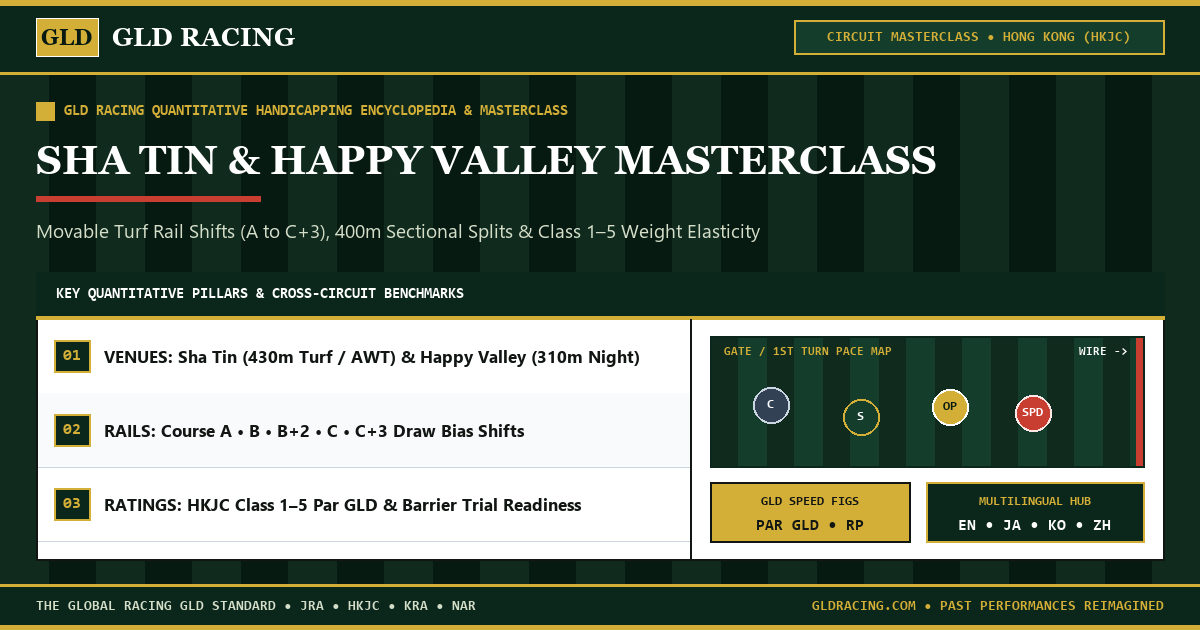
Circuit Masterclass 1 • HKJC14 min read
Master Hong Kong Jockey Club (HKJC) handicapping with empirical data from 48,557 HK starts inside our 865,435-start GLD Class Par repository. Learn how Sha Tin and Happy Valley movable rails (A to C+3) compress turn radius, how 20-point rating bands create hidden Class-Jump weight edges, and how Sha Tin All-Weather Track (AWT) physics invert turf running styles.
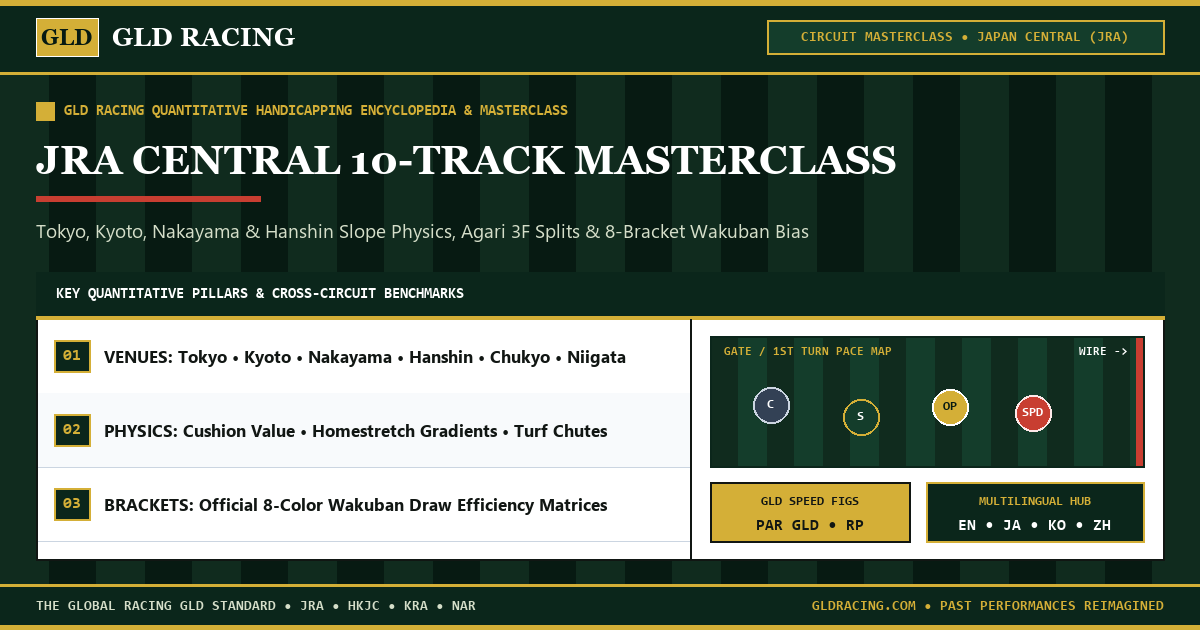
Circuit Masterclass 2 • JRA14 min read
Unlock Japan Racing Association (JRA) handicapping powered by 263,683 central starts in our GLD Class Par repository. Master the architectural contrasts between Tokyo, Nakayama, Kyoto, and Hanshin, normalize deceptive Agari 3F closing splits into Late Pace (LP) figures, and exploit JRA Cushion Values and 8-Bracket (Wakuban) turf-start dirt biases.
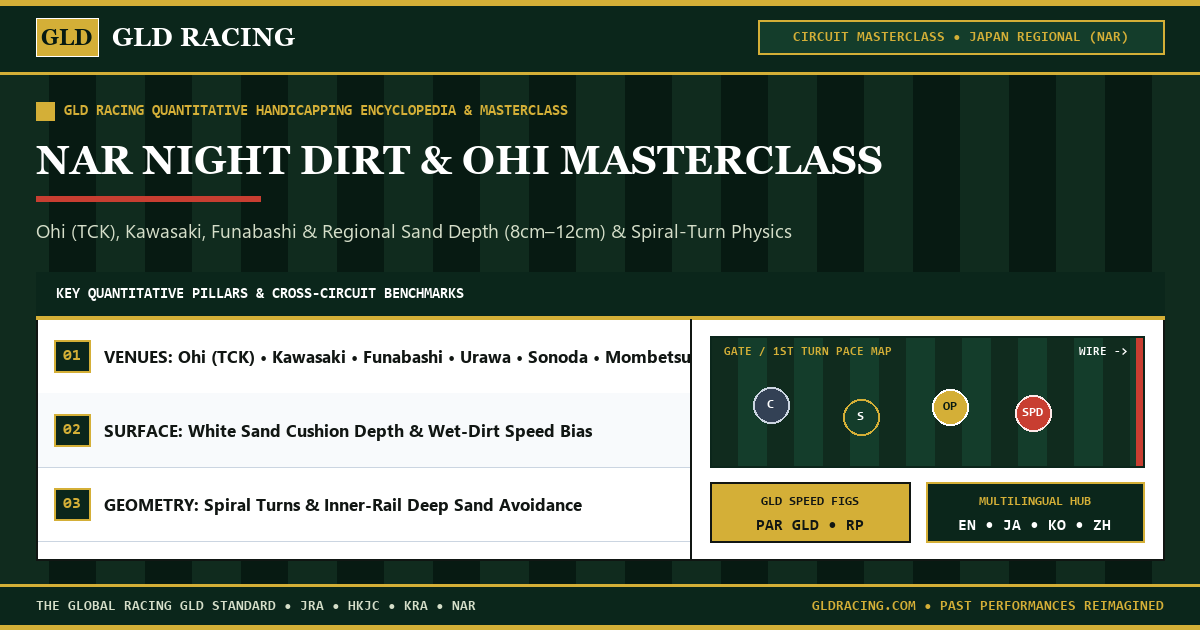
Circuit Masterclass 3 • NAR14 min read
Master Japan National Association of Racing (NAR) regional dirt handicapping backed by 386,781 NAR starts in our GLD Class Par repository. Learn how Ohi (Tokyo City Keiba) Australian white sand, Funabashi spiral curves, Kawasaki hairpins, and C3-to-A1 class par structures create massive GLD Line overlays.
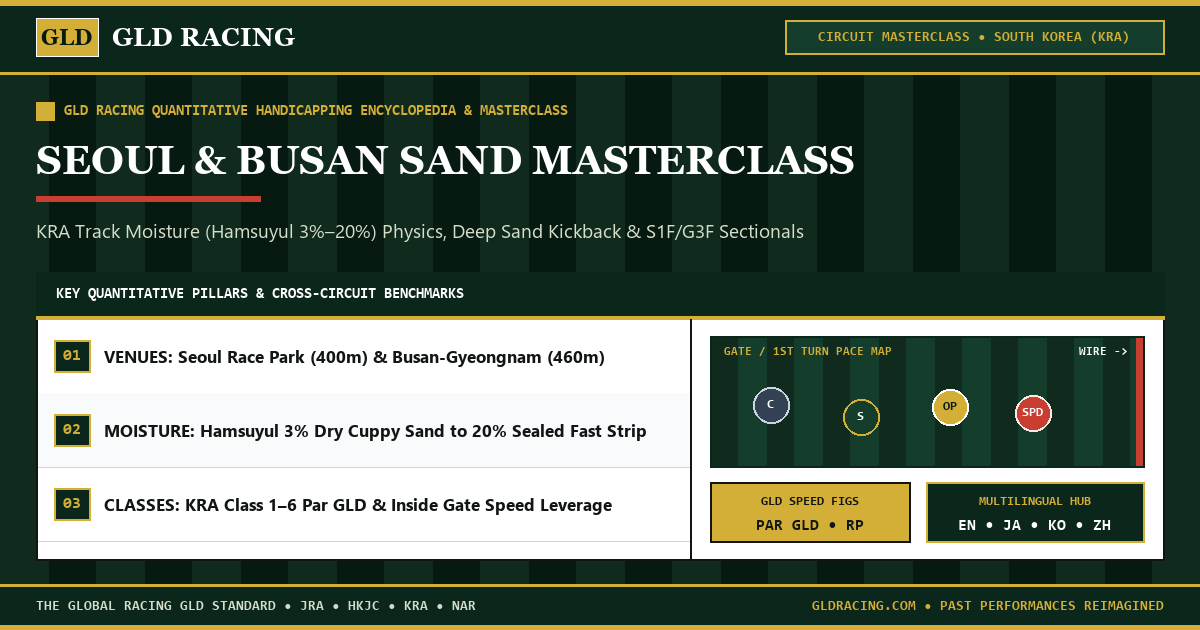
Circuit Masterclass 4 • KRA14 min read
Master Korea Racing Authority (KRA) handicapping powered by 96,959 verified KRA starts in our GLD Class Par repository. Learn how official track moisture percentage (Hamsuyul 3%-20%) flips sand velocity by over 2.5 seconds, why Gates 1-4 dominate at Seoul vs. Busan long-stretch closers, and how to handicap Class 6 to Class 1 promotions.
Interactive Handicapping Glossary & Quantitative Encyclopedia
Search and filter 44+ proprietary GLD metrics (GLD Speed Figure, Par GLD, RP, EP/MP/LP/PD, OWD, DI, Tomlinson) and regional terms (Agari 3F, Wakuban, Course A–C+3, Hamsuyul 3%–20%, Ohi Spiral Curve).
1. The Core Performance Figures
We calculate speed and class strength on a standardized scale to make comparing performances across different classes, tracks, and dates effortless.
GLD Speed Figure
Quantifies how fast a horse ran its individual race. It is normalized for distance, track conditions, daily wind variants, and track speed profiles to represent pure, isolated athletic velocity.
Race Power (RP)
The GLD Speed Standard of the competitive field in that race. Race Power is our assessment of how strong a race was. Look at how runners perform against races with similar or better Race Power to determine if they are out-classed or expected to be competitive.
GLD Power Rating
The weighted rolling average of a horse's recent performances, emphasizing its most recent starts, serving as our primary predictive baseline.
GLD Line (Projected Starting Odds)
Our proprietary projection of what odds a horse will go off at when the gates open (e.g. GLD Line: (7/2)). Because the Hong Kong Jockey Club publishes no official morning line, the GLD Line fills that vacuum by modeling public betting psychology and pool volume, calibrated directly to the HKJC's 17.5% parimutuel takeout. Displayed directly beneath the Pedigree and GLD Power Rating boxes, it gives you an objective price anchor 24 hours before post time.
Pedigree Rating & OWD
A score reflecting the historical aptitude and speed figures of the horse's sire and dam progeny at this specific distance and surface. Includes OWD (Offspring Winning Distance) indicating the genetic distance sweet spot of the lineage.
Race Par
The historical speed standard required to win a race of this specific class, distance, track layout, and surface. It represents the "par" score for a typical winner of this grade.
Proj. Race Power
The projected rating required to win today's race. It is calculated by looking at the power ratings of all runners entered in today's field to project the dynamic strength of the race.
💡 Finding Value Overlays: Power Rating vs. GLD Line
The secret to beating Hong Kong racing is comparing true ability against public price. Look for horses where our GLD Power Rating indicates top-tier contention, but the GLD Line projects double-digit odds (e.g. 10/1 or 15/1). That disconnect signals a prime value overlay. Conversely, horses with modest speed ratings projected at odds-on or short prices (e.g. 6/5) represent vulnerable underlays to stand against in exotics.
2. Pace Segments & Running Style Abbreviations
We evaluate each race using standardized pace figures to categorize running styles and measure energy distribution:
- EP (Early Pace): Measures the horse's initial velocity out of the gate up to the first call. High EP is essential for front-runners and speed horses.
- LP (Late Pace): Measures finishing stamina and closing speed in the final stretch. High LP identifies horses that close strongly from the back of the pack.
- PD (Pace Differential): The difference between Late Pace and Early Pace (LP - EP). Positive values (+PD) indicate strong closing acceleration; negative values (-PD) indicate early speed burners.
Core Running Style Classifications:
- SPD (Speed): Pacesetters and front-runners that contend for or control an uncontested early lead.
- OP (Off-Pace): Stalkers sitting right off the leading pace in a stalking position.
- PCK (Pack): Midfield runners traveling within the main body of the pack.
- C (Closer): Deep closers that sit back and unleash stamina in the final 400m.
3. Pace Projections & Layouts
The pace setup diagram at the top of the race page projects the field's running order at the first call. Leaders are displayed on the right, and closers on the left.
💡 The Speed Advantage
If exactly one runner is isolated on the far right and the rest are clustered > 4 lengths behind, that runner gets an uncontested lead. Front-running speed runners win at a disproportionately high rate as they can control the race tempo.
⚠️ The Pace Meltdown Danger
When four or more runners are bunched closely together near the lead line on the right, expect a fast, exhausting early speed duel. This layout sets the race up for a closer from the left with a high Late Pace (LP) rating.
4. Equipment Codes & Gear Change Markings Guide
In Hong Kong racing, equipment adjustments are among the most potent tactical tools used by trainers to sharpen focus, correct erratic racing manners, improve breathing, or manage high anxiety. In our past performances, equipment is reported using the official Hong Kong Jockey Club (HKJC) abbreviations alongside real-time modification status indicators.
Equipment Status Suffixes & Operational Markings
Every piece of equipment in a horse's past performance line can feature a status modifier indicating whether it is newly added, re-introduced, or removed:
1 (First Time Worn)The equipment is applied for the first time in an official race (e.g. B1, TT1, V1). Major angle for sudden tactical improvement and gate speed.
2 (Replaced / Re-fitted)The equipment is reintroduced after being taken off in prior starts, or a modified version is approved (e.g. B2, TT2, H2).
- (Removed / Taken Off)The gear is discarded for today's race (e.g. B-, PC-, TT-). Often indicates the horse was over-racing or pulling too hard and needs to settle.
No Suffix (Maintained)The gear was worn in the previous start and is maintained unchanged (e.g. B, TT, CP).
/ (Combination Separator)Separates multiple concurrent pieces of equipment worn in the same race (e.g. B/TT, PC-/B1/TT, V1/XB/TT2).
- or [--] (No Equipment)Indicates the horse ran completely natural without any authorized headgear, noseband, or tongue equipment.
Official Equipment Directory (Approved Racing Codes)
👁️ Eye & Vision Modifiers
B: Blinkers — Full cups blocking rear and lateral vision, forcing the horse to focus strictly forward and engage early.
BO: Blinker with One Cowl Only — Blinker cup fitted to one eye only; corrects horses that lug or hang in one direction.
V: Visor — Blinker cowl with a vertical slit, allowing a limited view of challenging horses to stimulate fighting spirit in a duel.
VO: Visor with One Cowl Only — Visor slit-cowl on one eye only to correct steering bias while retaining partial lateral awareness.
P: Pacifier — Fine mesh eye screens protecting against flying turf or abrasive sand/kickback on the All-Weather dirt track.
PC: Pacifier with Cowls — Mesh eye screen combined with blinker cowls, uniting dirt protection with restricted rear vision.
PS: Pacifier with One Cowl — Mesh eye screen on both eyes with a blinker cowl on one side only.
🎧 Calming & Noise Dampening
H: Hood — Padded neoprene/fabric cover over the ears and poll; muffles crowd noise to soothe anxious, agitated runners.
E: Ear Plugs — Acoustic sponge plugs inserted directly into ears to prevent panic from starting stalls and roaring crowds.
🐑 Sheepskin & Focus Rolls
CP: Sheepskin Cheek Pieces — Fluffy fleece rolls on the bridle cheekstraps; restricts rear vision more gently than rigid blinkers.
CO: Sheepskin Cheek Piece (One Side) — Cheek piece fitted to one side only to help jockeys correct track bias or uncooperative steering.
SR: Shadow Roll — Sheepskin roll across the nose; prevents the horse from lowering its head to spook at track shadows or turf lines.
SB: Sheepskin Browband — Sheepskin roll across the forehead above the eyes to block overhead glare and distractions.
🫁 Mouth, Tongue & Respiratory Control
TT: Tongue Tie — Strap securing the tongue to the lower jaw; stops the horse getting its tongue over the bit or choking down under stress.
XB: Crossed Noseband — Figure-eight noseband across the muzzle; prevents the horse from opening its mouth to evade the bit, ensuring responsive steering.
CC: Cornell Collar — Specialized veterinary harness stabilizing the larynx to prevent soft palate displacement (DDSP) and airway collapse.
⚙️ Bit & Plates Control
EB: Eggbutt Bit (蛋形大口銜) — Smooth fixed-ring snaffle bit preventing cheek pinching; provides steady, gentle turning contact on dirt corners.
HC: Half Cheek Bit (半頰大口銜) — Snaffle with lower cheek bars preventing bit pull-through; delivers direct steering leverage during tight homestretch duels.
LB: Lugging Bit (防傾口銜 / JR러깅) — High-leverage bit to counter severe outward or inward lugging, guaranteeing a straight line in deep sand tracks.
TB: Triabit (三合一口銜) — Ergonomic racing bit relieving tongue and palate pressure to keep upper airways clear while preserving sharp handling.
AB: Approved Bit (認可口銜) — Official certified regulation snaffle bit ensuring standard mouth contact and responsive steering.
AP: Approved Plates (認可蹄鐵) — Official racing plates engineered for secure traction and sound galloping posture over dirt and sand tracks.
📖 Deciphering Real-World Past Performance Examples
• B1/TT : Blinkers worn for the first time, Tongue Tie maintained. (High-intent tactical maneuver to spark gate speed).
• PC-/B1/TT : Pacifier with cowls removed, Blinkers applied first time, Tongue Tie maintained.
• V-/TT1 : Visors removed, Tongue Tie added for the first time. (Removes visual intensity while addressing a breathing issue).
• XB-/E/SR/TT2 : Crossed Noseband removed, Ear Plugs maintained, Shadow Roll maintained, Tongue Tie re-fitted.
• - or [-] : Completely natural running line with no equipment worn.
5. Past Performance Grid Layout
Click on any runner inside the cards list to toggle their last five running lines:
| Column | Indicator | Explanation |
|---|
| Date | Race Date | Click the date link (e.g. 26Apr26 ▶) or tap the video link to open the official HKJC replay video. |
| Trk / Surf | Track / Surface | Track layout (HV Happy Valley, ST Sha Tin) and turf/dirt indicator (TRF, AWT). |
| Dist | Distance | Metres run (e.g. 1200m). |
| Jockey / Draw | Rider / Post | Current jockey and starting draw position. Check the draw number for post position advantage. |
| RP | Race Power | The GLD Speed Standard of the competitive field in that race. Race Power is our assessment of how strong a race was. Look at how runners perform against races with similar or better Race Power to determine if they are out-classed or expected to be competitive. |
| GLD | Speed Rating | The individual speed figure achieved in that start. High figures are highlighted for easy identification. |
| EP / LP / PD | Pace Splits & Differential | Normalized early pace (EP), late closing pace (LP), and pace differential (PD = LP - EP). Used to identify running style, stamina limits, and closing acceleration. |