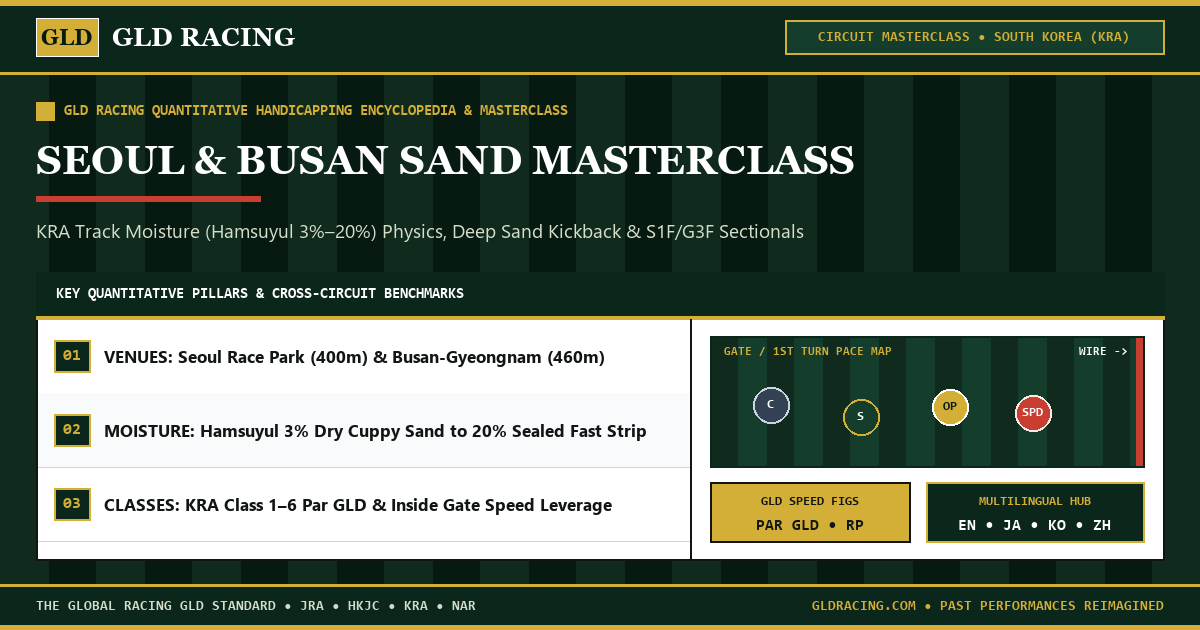
Korea Racing Authority (KRA / 한국마사회) thoroughbred racing at LetsRun Park Seoul and LetsRun Park Busan-Gyeongnam sits at Priority 3 in GLD Racing's international hierarchy—immediately following JRA Central Racing and Hong Kong—and represents one of the fastest-growing international simulcast pools in the world, highlighted by the international Grade 3 Korea Cup and Korea Sprint won by global stars alongside Korean champions like GLOBAL HIT and WINNER STAR. Inside our 865,435-start GLD Class Par benchmark repository, KRA racing is anchored by 96,959 verified starts (International Class Par Benchmarks).
Unlike turf circuits where firm ground is fast and wet ground is slow, Korean racing is contested exclusively on deep washed silica river and coastal sand (9cm to 10cm cushion depth). Because KRA stewards publish the exact Track Moisture Percentage (Hamsuyul / 함수율, ranging from 2% to 20%+) before every card, Korean sand racing is a quantitative handicapper's paradise. This masterclass connects the Korea Racing Hub (`/ko`), Japan Racing Hub (`/ja`), and Hong Kong Racing Hub (`/zh`) with the exact physics of KRA moisture bands, inside gate speed bias, and Seoul vs. Busan stretch geometry.
1. Track Moisture Percentage (Hamsuyul 3%–20%): The Five KRA Going Bands
Before wagering a single unit on Seoul or Busan, your first check must always be the official KRA Track Moisture Percentage (Hamsuyul / 함수율) and our Track Going & Moisture Impact (`/stats/going-impact`) calibration table. Korean sand is divided into five official moisture bands that completely invert track speed and running-style bias:
- Dry / Standard Sand (
건조/ Dry:1%–5%Moisture):
When moisture drops below 6% during dry spring, autumn, or sunny afternoon cards, the loose quartz sand grains lack cohesive surface tension. Hooves sink deeply into the 10cm cushion, kickback is severe, and raw 1200m–1800m times run +0.7s to +1.3s slower than median par. Early speed duels burn out in the deep sand, giving high-stamina stalkers (OP) and sustained closers (LP) their best chance to reel in tired leaders.
- Good Sand (
양호/ Good:6%–9%Moisture):
The baseline equilibrium band where standard Empirical Par Times (GLD Class Par) and Par GLD benchmarks are anchored (How GLD Speed Figures Work).
- Slightly Heavy / Good-to-Yielding Sand (
다습/ Moist:10%–14%Moisture):
Here the linguistic trap catches uninitiated bettors: in English translations, 10%–14% moisture is often labeled "Yielding" or "Slightly Heavy," leading turf bettors to expect a slow track. In reality, moisture between 10% and 14% binds the sand grains together into a firm, springy surface! Raw times accelerate by -0.6s to -1.1s faster than Good sand, and inside front-runners (SPD) gain a pronounced edge.
- Wet / Heavy Sand (
포화/ Saturated:15%–19%Moisture):
Water saturates the sand matrix and maintenance rollers pack the surface into a lightning-fast runway. Raw times drop by -1.3s to -1.9s, kickback turns into heavy wet spray that blinds backmarkers, and Early Pace (EP) leaders drawn in Gates 1–4 become nearly impossible to catch.
- Sloppy / Sealed Sand (
불량/ Sloppy:20%+Moisture):
Standing water seals the top of the sand track. Raw times run -1.8s to -2.5s faster than dry sand! Closing from behind (C) is virtually impossible over 1000m–1400m sprints; upgrade high-EP SPD runners and horses with high wet-sand Tomlinson pedigree scores.
2. Seoul vs. Busan-Gyeongnam Architectural Contrast
While both KRA venues run left-handed (counter-clockwise) on sand, their oval circumferences and homestretch geometries produce starkly different tactical dynamics (explore full KRA track profiles on `/ko`):
- LetsRun Park Seoul (Left-Handed •
1800mOuter Oval /1600mInner Oval •525mStretch with Uphill Rise):
Despite having a long 525m homestretch, Seoul utilizes a tighter inner turn transition on several configurations and features a punishing inside gate speed bias over Seoul 1000m, 1200m, 1300m, and 1400m. Why? Because deep sand kickback in the middle lanes intimidates horses stuck behind a wall of runners, while horses breaking cleanly from Gates 1–4 save ground on the rail and avoid kickback entirely. Over Seoul 1200m, Gates 1–4 achieve a 12.1% strike rate vs 5.5% for Gates 9+ (/stats/track-bias). Over two-turn routes (Seoul 1700m, 1800m, 2000m), the short run to the first turn makes inside draws and tactical EP even more decisive.
- LetsRun Park Busan-Gyeongnam (Left-Handed •
2000mSweeping Oval •560mStretch):
Opened in 2005 with modern championship geometry, Busan features a sweeping 2000m circumference—200 meters wider than Seoul—and the longest dirt homestretch in Korea (560m from the 4th corner exit). Because the turns are wider and more gradual, wide-drawn horses lose far less momentum around the bend, and the massive 560m straight gives high Late Pace (LP) stalkers (OP) and closers (C) ample time to run down tired speed horses over Busan 1400m, 1600m, and 1800m. When Busan ships top horses like GLOBAL HIT to Seoul for inter-track championship races, Busan-trained horses often possess superior sustained MP and LP stamina!
3. Empirical KRA Class Par & Gate Bias Matrix (GLD Class Par)
Across our 96,959 verified KRA starts, Korean runners progress from domestic maidens (Class 6) through Class 5 → Class 4 → Class 3 → Class 2 → Class 1 / Graded Open. Here are the empirical standards (view all 228 rows on `/stats/class-pars`):
| KRA Venue & Surface | Distance | Official Class Tier | Empirical Par Time (GLD Class Par) | Par Velocity (m/s) | Benchmark Par GLD | Inside (1–4) Strike Rate | Outside (9+) Strike Rate | Key Moisture & Sectional Physics Edge |
|---|---|---|---|---|---|---|---|---|
| Seoul Dirt | 1200m | Class 1 | 1:11.95 | 16.68 m/s | 98 | 11.8% | 5.8% | Elite sprint speed; wet sand (>=12%) favors SPD |
| Seoul Dirt | 1200m | Class 3 | 1:13.20 | 16.39 m/s | 84 | 12.0% | 5.6% | Strong Gates 1–4 rail bias; target high EP |
| Seoul Dirt | 1200m | Class 4 | 1:13.85 | 16.25 m/s | 78 | 12.1% | 5.5% | Foreign imports debut here; check FTS Pedigree |
| Seoul Dirt | 1200m | Class 5 | 1:14.65 | 16.08 m/s | 71 | 12.2% | 5.4% | Upgrade Class 6 winners posting GLD 72+ |
| Seoul Dirt | 1200m | Class 6 | 1:15.50 | 15.89 m/s | 64 | 12.5% | 5.2% | Domestic maiden class; lone SPD dominates |
| Seoul Dirt | 1800m | Class 1 / Open | 1:54.40 | 15.73 m/s | 100 | 11.4% | 6.0% | Two-turn route; short run to 1st turn favors Gates 1–4 |
| Busan Dirt | 1200m | Class 4 | 1:13.45 | 16.34 m/s | 79 | 10.2% | 7.1% | 0.40s faster base than Seoul; fair 560m stretch |
| Busan Dirt | 1400m | Class 3 | 1:25.80 | 16.32 m/s | 85 | 9.8% | 7.5% | Sweeping 2000m oval rewards OP stalkers + LP |
| Busan Dirt | 1600m | Class 2 | 1:39.10 | 16.15 m/s | 91 | 9.6% | 7.6% | Long one-turn chute run-up; positive PD closers |
| Busan Dirt | 1800m | Class 1 / Open | 1:53.60 | 15.85 m/s | 100 | 9.5% | 7.8% | Championship route; Busan shippers hold stamina edge |
4. Handicapping KRA Class Jumps (Class 6 to Class 1) & Foreign Imports
When analyzing a KRA racecard (explore our Free Interactive Sample Racecard), combine Par GLD vs. Race Power (RP) (read the Class Par guide) with two uniquely Korean class rules:
- The Class 6 → Class 5 Promotion: Domestic Korean-bred horses start in Class 6 (Par GLD 64). When a 3-year-old wins a Class 6 sprint in
1:14.20on Good sand (GLD Speed Figure 74), it has already exceeded the Class 5 Par GLD (71) by 3 full points—and upon promotion to Class 5, it typically drops3kg to 4kgin assigned weight! Conversely, a Class 6 winner that crawled home in1:16.10(GLD Figure 60) is a prime false favorite to bet against in Class 5. - Class 4 Foreign-Bred Imports: Imported thoroughbreds (primarily American dirt bloodlines by sires like
INTO MISCHIEF,TAPIT,MUNNINGS, andPRACTICAL JOKE) bypass Classes 6 and 5 entirely and debut directly in Class 4 (Par GLD 78). Always check our GLD Master Pedigree Rating and Early Pace (EP) barrier trial sectionals (First-Turn Pace Maps Guide) to isolate US-bred colts ready to wire Class 4 on debut at generous GLD Line overlays.
Frequently Asked Questions (FAQ)
Q1: Does higher track moisture (Hamsuyul 15%–20%) make Korean sand tracks slower or faster?
Faster! Unlike turf courses that slow down when wet, Korean river and coastal sand compacts tightly when moisture rises into the Moist (10%–14%), Wet/Saturated (15%–19%), and Sloppy (20%+) bands. A 17% moisture track at Seoul or Busan runs -1.3s to -2.0s faster over 1200m–1400m than a bone-dry 4% moisture track, heavily favoring inside front-runners (SPD) (/stats/going-impact).
Q2: Why do inside gates (Gates 1–4) have a stronger bias at Seoul than at Busan-Gyeongnam?
Seoul has a 1600m/1800m inner/outer oval with tighter turn transitions and severe sand kickback in the middle lanes, giving Gates 1–4 a 12.1% strike rate over 1200m vs 5.5% for Gates 9+. Busan features a wider 2000m sweeping oval and a 560m homestretch, allowing outer draws and high Late Pace (LP) closers to make up ground much more effectively (/stats/track-bias).
Q3: Why do Busan-trained horses often outperform Seoul horses in inter-track championship races?
As shown in our GLD Class Par benchmark matrix (/stats/class-pars), Busan races are contested at a 0.35s to 0.80s faster raw pace across identical class tiers, and its 560m stretch demands sustained Mid-Race (MP) and Late Pace (LP) stamina. When raw times are normalized into GLD Speed Figures, top Busan shippers frequently hold a hidden +3 to +5 point rating advantage over local Seoul favorites.
Q4: How should I handicap a Class 6 maiden winner stepping up into Class 5 for the first time?
Check whether the horse's Class 6 winning GLD Speed Figure already matches or beats the Class 5 Par GLD of 71 (and today's Race Power RP). Because KRA handicappers drop newly promoted Class 5 runners down to 52kg–53kg, a Class 6 winner that posted a 72+ GLD Figure is a high-value win and Quinella anchor, whereas a slow Class 6 winner (GLD <= 63) should be faded.
GLD Racing is an independent analytical service and is not affiliated with or endorsed by The Hong Kong Jockey Club (HKJC), Japan Racing Association (JRA), National Association of Racing (NAR), or Korea Racing Authority (KRA). All data and speed figures are provided for informational and analytical purposes. 18+ | Please Gamble Responsibly.