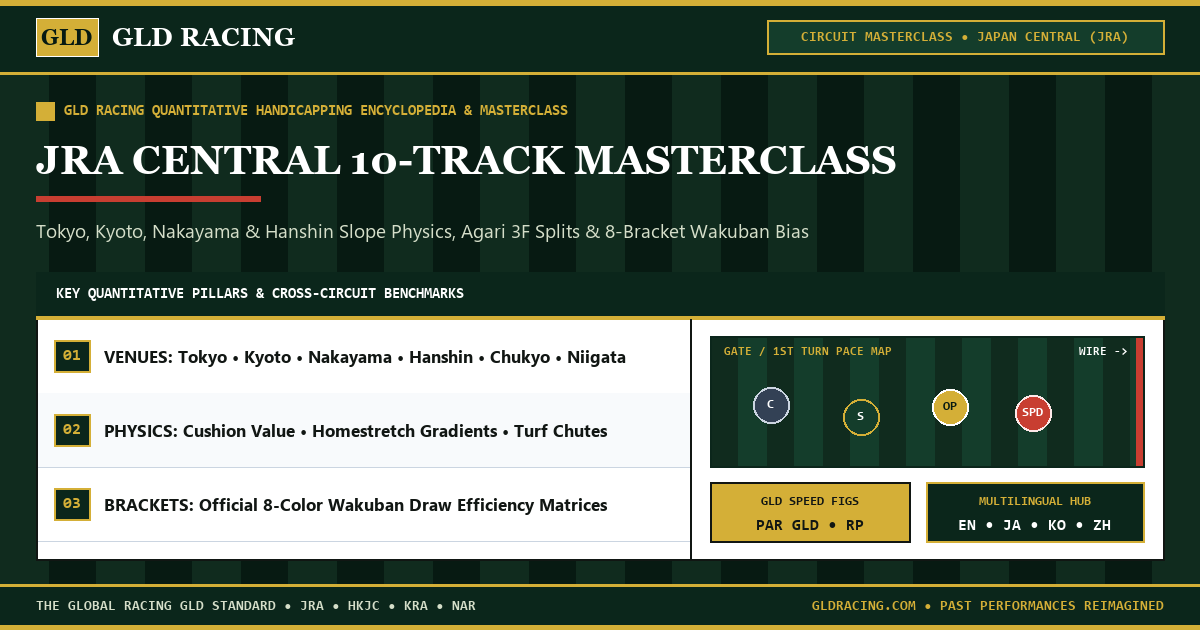
Japan Racing Association (JRA) central racing represents Priority 1 in GLD Racing's global hierarchy—featuring the deepest thoroughbred talent pool on the planet, massive pari-mutuel liquidity, and world-dominating champions such as EQUINOX, DO DEUCE, LIBERTY ISLAND, and LEMON POP. Yet international and domestic horseplayers alike fall into a recurring analytical trap when handicapping JRA cards: they treat all Japanese turf and dirt courses as interchangeable and blindly bet whichever runner printed the fastest raw Final 3 Furlongs (Agari 3F / 上り3F / last 600m) in its previous start.
In reality, a 33.1s closing split on the sweeping left-handed galloping strip at Tokyo Racecourse is governed by completely different physics than a 34.8s closing grind up the brutal 2.2m homestretch cliff at Nakayama Racecourse or a downhill sling-shot off the 3rd-corner hill at Kyoto Racecourse. Calibrated across 263,683 JRA starts inside our 865,435-start GLD Class Par benchmark repository (International Class Par Benchmarks), this masterclass details how to handicap Japan's four flagship central venues using standardized GLD Speed Figures, Late Pace (LP) sectionals, JRA Cushion Values, and 8-Bracket (Wakuban / 枠番) geometry across the Japan Racing Hub (`/ja`), Hong Kong Racing Hub (`/zh`), and Korea Racing Hub (`/ko`).
1. The JRA "Big Four" Architectural Matrix: Tokyo, Nakayama, Kyoto & Hanshin
To handicap JRA racing profitably, you must first separate galloping stamina-kick tracks from tight-turning early-speed tracks and downhill momentum tracks (explore all 10 JRA venue profiles on `/japan/jra`):
- Tokyo Racecourse (Left-Handed •
525.9mTurf Straight •2.1mUphill Climb •501.6mDirt Straight):
Located in Fuchu, Tokyo is Japan's supreme test of sustained closing velocity (LP). After rounding a sweeping home turn, runners face the famous 2.1m "Dandaka-zaka" uphill climb mid-stretch before leveling out for the final 300 meters. Front-runners (SPD) that burn excessive Early Pace (EP) before the hill hit an anaerobic wall, allowing elite stalkers (OP) and closers (C) like EQUINOX and DO DEUCE to dominate over Tokyo 1600m, 2000m, and 2400m.
- The Tokyo Dirt 1600m Turf-Start Bias: On dirt, Tokyo 1600m starts in a turf chute! Runners drawn in outer brackets (Brackets 6, 7, and 8 — Green, Orange, Pink) gallop on turf for nearly 150 meters longer than inside brackets (Brackets 1–2), achieving superior acceleration into the backstretch.
- Nakayama Racecourse (Right-Handed •
310.0mTurf Straight •2.2mSteep Cliff):
Nakayama is Tokyo's exact geometric opposite: a tight-turning oval with one of the shortest homestretches in central racing (310.0m), punctuated by a punishing 2.2m uphill rise (1.43% gradient) in the final 200 meters. Over Nakayama 1200m and 1800m, wide-drawn closers cannot make up ground around the tight 3rd and 4th turns; inside draws (Gates 1–4) post an 11.8% strike rate vs 5.4% for outside draws (/stats/track-bias). Horses shipping from a 6th-place finish at Tokyo with high EP frequently wire the field at Nakayama.
- Kyoto Racecourse (Right-Handed •
403.7mOuter Flat Straight •4.3m3rd-Corner Hill):
Renovated with a world-class grandstand and drainage profile, Kyoto features zero uphill climb in the homestretch—the final 400 meters are dead flat! Instead, the elevation test occurs at the 3rd corner ("Yodo-no-saka", up to 4.3m on the Outer Course). Riders must conserve energy climbing the backstretch hill and use the steep downhill descent into the 4th corner to slingshot into the flat stretch. High Mid-Race Pace (MP) and early-gear LP momentum reign supreme over Kyoto 1600m and 3200m.
- Hanshin Racecourse (Right-Handed •
473.6mOuter Straight •1.8mSteep Final Climb):
Hanshin splits into two distinct tracks: the Inner Course (356.5m stretch, used for 1200m, 1400m, 2000m, and 2200m Takarazuka Kinen) which favors tactical OP stalkers, and the expansive Outer Course (473.6m stretch, used for Hanshin 1600m and 1800m) where a long gentle downhill run leads into a sharp 1.8m uphill rise inside the final 200 meters—rewarding explosive LP closers like LIBERTY ISLAND.
2. Empirical JRA Class Par & Track Bias Matrix (GLD Class Par)
Across our 263,683 JRA starts, here is how standard winning times, velocities (m/s), Benchmark Par GLD figures, and gate biases align across Japan's premier central courses (view all 228 rows on `/stats/class-pars`):
| JRA Venue & Surface | Distance | Official Class Tier | Empirical Par Time (GLD Class Par) | Par Velocity (m/s) | Benchmark Par GLD | Inside (1–4) Strike Rate | Outside (9+) Strike Rate | Key Architectural & Sectional Edge |
|---|---|---|---|---|---|---|---|---|
| Tokyo Turf | 1600m | Grade 1 (G1) | 1:33.67 | 17.08 m/s | 118 | 8.4% | 7.9% | 525.9m stretch + 2.1m hill; top LP (Agari 3F <= 33.3s) |
| Tokyo Turf | 1600m | 3-Win Class | 1:33.95 | 17.03 m/s | 92 | 8.6% | 8.0% | Balanced galloping strip; high PD stalkers & closers |
| Tokyo Turf | 1600m | 1-Win Class | 1:34.55 | 16.92 m/s | 76 | 8.8% | 7.8% | Upgrade 3YO improvers beating Par GLD 76 |
| Tokyo Turf | 2400m | Grade 1 (G1) | 2:23.85 | 16.68 m/s | 118 | 9.4% | 6.8% | Japan Cup / Derby; Brackets 1–3 save ground on 1st turn |
| Tokyo Dirt | 1600m | 2-Win Class | 1:36.82 | 16.53 m/s | 84 | 6.9% | 10.4% | Turf-start chute strongly upgrades Outer Brackets 6–8 |
| Nakayama Turf | 1200m | Grade 1 (G1) | 1:07.48 | 17.78 m/s | 118 | 11.8% | 5.4% | Downhill start + 310m stretch; Gates 1–4 SPD/OP |
| Nakayama Turf | 2000m | 3-Win Class | 1:59.42 | 16.75 m/s | 92 | 10.9% | 6.2% | Climbs 2.2m hill twice; requires high stamina OWD |
| Kyoto Turf | 1600m Outer | Grade 1 (G1) | 1:32.98 | 17.21 m/s | 118 | 9.1% | 8.3% | 3rd-corner 4.3m hill + flat stretch; high MP + LP |
| Hanshin Turf | 1600m Outer | Grade 1 (G1) | 1:33.32 | 17.14 m/s | 118 | 8.7% | 8.1% | 473.6m outer stretch + 1.8m hill; elite LP closers |
| Hanshin Dirt | 1800m | 3-Win Class | 1:51.90 | 16.09 m/s | 92 | 8.5% | 8.8% | Tight 4-turn dirt; wet dirt (>= 12% moisture) favors SPD |
3. Deconstructing Agari 3F Splits, JRA Cushion Values & Turf/Dirt Moisture Inversion
Every Friday and Saturday morning before central races begin, the JRA publishes two critical physical measurements that directly drive our Track Going & Moisture Impact (`/stats/going-impact`) adjustments:
- JRA Turf Cushion Value (
Cushion Value): Measured in Gs of vertical impact deceleration: - High Cushion (
10.0 to 11.2— Firm / Fast Opening Week Turf): The turf root mat acts like a trampoline. Horses glide across the top of the ground, raw times drop by-0.6s to -1.1s, and inside-rail speed (SPD/OP) combined with sub-33.2sAgari 3Fsplits dominates. - Standard Cushion (
9.0 to 9.9— Good Standard Turf): Balanced equilibrium where GLD Speed Figures and Late Pace (LP) ratings hold true across all lanes. - Low Cushion (
7.2 to 8.6— Rain-Softened / Late-Meet Chewed Turf): Hooves sink deeply into the turf, slowing raw times by+1.4s to +2.2s. Lightweight speedster favorites collapse, while European-bred stamina bloodlines with high Tomlinson wet-turf ratings surge from outer lanes. - JRA Dirt Goal / 4th-Corner Moisture (
2%Dry to18%Sloppy):
Unlike turf, Japanese dirt is composed of washed coastal sand (9cm depth). When bone-dry (2%–5% moisture), the loose sand absorbs kinetic energy (+0.8s slower), turning 1800m dirt races into power grinds. When rain elevates moisture to 12%–18% (Yielding / Heavy / Sloppy), surface tension compacts the sand grains and accelerates race times by -1.2s to -1.6s—creating an extreme front-running speed highway (How GLD Speed Figures Work).
4. Official 8-Bracket (Wakuban) Geometry & Apprentice Weight Allowances
On every GLD Racing Japan card (test the Free Sample Racecard Preview), runners are grouped into Japan's official 8-Color Bracket System (Wakuban / 枠番 1–8) alongside their individual horse numbers (Umaban 1–18):
- Bracket 1 (White) & Bracket 2 (Black): Inside rail savers—prime overlays on opening-week
Course Aturf at Nakayama and inner-loop Hanshin. - Bracket 3 (Red), Bracket 4 (Blue), Bracket 5 (Yellow), Bracket 6 (Green): Middle tactical brackets offering flexible two-wide stalking trips (
OP). - Bracket 7 (Orange) & Bracket 8 (Pink): Outer brackets—advantaged on turf-start dirt chutes (Tokyo Dirt 1600m, Nakayama Dirt 1200m, Hanshin Dirt 1400m) where outer stalls enjoy a longer turf run-up, as well as late-meet turf when the inside rail is chewed up.
Additionally, always watch for JRA Apprentice & Female Jockey Weight Allowance Symbols (★ -4kg, ▲ -3kg, △ -2kg, ☆ -1kg, ◇ -2kg permanent allowance). In 1-Win and 2-Win dirt sprints where a ▲ (-3kg) apprentice pilots a high-EP SPD runner drawn well, the 3kg (6.6 lbs) weight reduction provides a massive gate-to-wire advantage over the GLD Line.
Frequently Asked Questions (FAQ)
Q1: Why is a raw 33.4-second Agari 3F split sometimes rated lower than a 34.9-second Agari 3F split in GLD Late Pace (LP)?
Raw Agari 3F times depend heavily on race distance, opening pace, and surface going. In a slow-paced 1600m race on high-cushion firm turf at Tokyo, almost the entire field finishes in 33.4s–33.8s. Conversely, clocking 34.9s up the steep 2.2m hill at Nakayama after a fast opening pace—or on soft turf—represents a far superior athletic closing effort once normalized into our Late Pace (LP) index (/articles/first-turn-pace-maps-ep-lp-sectional-physics-guide).
Q2: Which JRA dirt courses have a turf start, and why do outer brackets (Brackets 7 & 8) benefit?
Key JRA turf-start dirt courses include Tokyo Dirt 1600m, Nakayama Dirt 1200m, Kyoto Dirt 1400m, and Hanshin Dirt 1400m. Because the transition from the turf chute onto the main dirt oval cuts across diagonally, horses drawn in outer Brackets 7 (Orange) and 8 (Pink) run on faster turf for 100 to 150 meters longer than Bracket 1 (White), allowing them to build higher Early Pace (EP) velocity.
Q3: How should I adjust my handicapping when JRA Turf Cushion Value drops below 8.8 or rises above 10.2?
When Cushion Value rises above 10.2 (Firm/Fast), upgrade inside draws (Brackets 1–3) and horses with high EP or elite sub-33.3s firm-turf acceleration. When Cushion Value drops below 8.8 (Soft/Yielding), downgrade lightweight speed favorites and upgrade runners with high GLD Master Pedigree wet-turf ratings and proven stamina (/stats/going-impact).
Q4: How do I evaluate a 3-year-old facing older horses for the first time in JRA 1-Win or 2-Win classes in Summer/Autumn?
Compare the 3-year-old's recent GLD Speed Figures directly against the older class benchmark (Par GLD 76 for 1-Win, Par GLD 84 for 2-Win) and today's Projected Race Power (RP) (read our Par GLD vs. Race Power guide). Because 3-year-olds receive weight-for-age allowances in summer and early autumn, a 3YO already posting a 78+ GLD figure against fellow 3YOs is a prime overlay against stagnant older 1-Win runners.
GLD Racing is an independent analytical service and is not affiliated with or endorsed by The Hong Kong Jockey Club (HKJC), Japan Racing Association (JRA), National Association of Racing (NAR), or Korea Racing Authority (KRA). All data and speed figures are provided for informational and analytical purposes. 18+ | Please Gamble Responsibly.