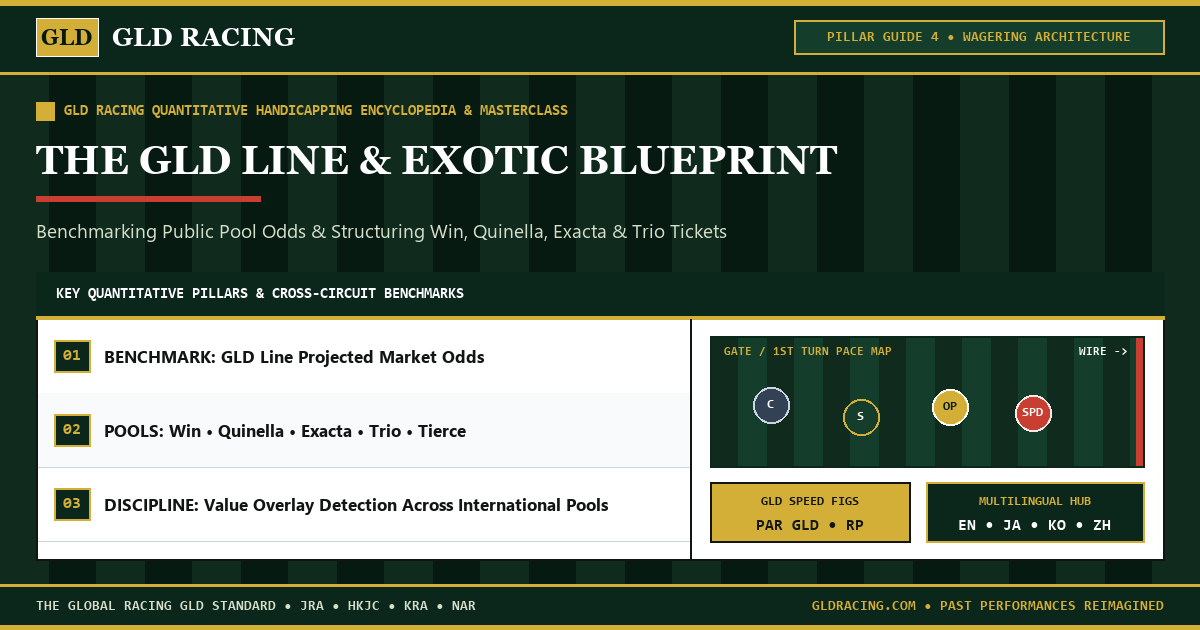
Even the sharpest speed figure and pace handicapper will go broke if they consistently bet horses at prices shorter than their true underlying merit. In pari-mutuel horse racing across Japan (JRA and NAR), Hong Kong (HKJC), and South Korea (KRA), you are not betting against a fixed-odds bookmaker—you are competing directly against the rest of the wagering public inside a shared pool after the racing authority deducts a 17.5% to 27.5% takeout commission.
Because neither the Hong Kong Jockey Club, the Japan Racing Association, nor the Korea Racing Authority publishes an official morning line on racecards, recreational bettors are often forced to anchor their opinions to whatever flashing numbers appear on the tote board 15 minutes before post time. To eliminate that blind spot, GLD Racing created the GLD Line: our proprietary projected public market odds benchmark printed on every runner card across Japan (`/ja`), Hong Kong (`/zh`), and South Korea (`/ko`). This guide provides the complete blueprint for comparing the live tote board against the GLD Line, stripping pari-mutuel takeout, and structuring high-leverage Quinella, Exacta, and Trio tickets.
1. What Is the GLD Line? Solving the Pari-Mutuel Pricing Blind Spot
Displayed directly beneath each horse's pedigree and GLD Power Rating on the Free Sample Racecard Preview (for example, GLD Line: (7/2) or 4.5), the GLD Line represents our quantitative projection of where an efficient, well-informed pari-mutuel market should price that contender once track takeout is accounted for.
The GLD Line synthesizes four core inputs calibrated across our 865,435-start GLD Class Par benchmark dataset:
- Standardized Velocity & Projected GLD Power Rating: How the runner's recency-weighted speed figures compare against today's
GLD Class ParPar GLD and Projected Race Power (`RP`). - Tactical Pace & Course Bias Alignment: Whether today's First-Turn Pace Map (`EP` vs. `LP`), barrier draw (/stats/track-bias), and surface moisture state (/stats/going-impact) amplify or penalize the runner's style.
- Pedigree & Surface-Switch Priors: Genetic suitability via our GLD Master Pedigree Rating and Offspring Winning Distance (OWD) (/hk/pedigree) for lightly raced runners.
- Public Pool Psychology & Takeout Normalization: How pari-mutuel pools distribute money across favorites versus longshots under each jurisdiction's exact statutory deduction structure.
2. International Pari-Mutuel Pool Structures & Takeout Mathematics
Every wager type carries a different statutory takeout rate (the percentage deducted by the track before paying winning tickets) and different variance characteristics. Understanding which pools offer the lowest takeout and highest pricing inefficiency is critical:
| Wager Type | JRA / NAR Japan Term | Hong Kong (HKJC) Term | South Korea (KRA) Term | Typical Pool Takeout Range | Core Quantitative Use Case (GLD Class Par) |
|---|---|---|---|---|---|
| Win | Tansho | Win | Danseung | 17.5% (HK) / 20.0% (JP & KR) | Isolating single-horse GLD Line overlays at 4/1 (5.0) or higher |
| Quinella | Umaren (1st & 2nd any order) | Quinella | Bokseung | 17.5% (HK) / 22.5% (JP) / 27.0% (KR) | Lowest-variance two-horse exotic; ideal for pairing an OP anchor with a high-LP closer |
| Exacta | Umatan (1st & 2nd exact order) | Forecast / Exacta | Ssangseung | 19.5% (HK) / 25.0% (JP) / 27.0% (KR) | High-leverage directional key when an inside SPD leader or hidden class dropper stands out on top |
| Trio | Sanrenpuku (1st, 2nd & 3rd any order) | Trio | Sambokseung | 25.0% (HK & JP) / 27.0% (KR) | Best multi-runner vehicle for pace meltdowns where a double-digit high-LP closer hits the frame |
| Trifecta / Tierce | Sanrentan (1st, 2nd & 3rd exact order) | Tierce | Samssangseung | 25.0% (HK) / 27.25% (JP) / 27.0% (KR) | High-payout vertical structure when top-rated GLD anchor is keyed in 1st & 2nd slots |
Notice why the HKJC Win and Quinella pools (17.5% takeout) and JRA Win (20.0%) / Umaren (22.5%) are prized by institutional syndicates: lower takeout means a smaller hurdle is required to turn a positive edge over the GLD Line into long-term bankroll growth.
3. Isolating Value Overlays vs. Fading Public Underlays
To find actionable value on any racecard, compare the live tote board odds against the GLD Line using three strict rules:
Rule 1: The Primary Value Overlay (Tote Significantly Higher Than GLD Line)
An Overlay occurs when a horse with top-tier GLD Speed Figures (/articles/gld-speed-figures-methodology-track-variants-guide) is trading at substantially higher odds on the public tote board than its projected GLD Line.
- Example: Suppose a runner at Sha Tin 1600m or Tokyo 1600m carries a GLD Line of
7/2(4.5), ranking #1 or #2 in GLD Power Rating, but is drifting at8/1(9.0) on the live tote board because it finished 6th in a brutally strongRP 94race last time out. - The public is reacting to the ugly "6th" finish column; the GLD Line recognizes the hidden class relief (/articles/par-gld-vs-race-power-class-drop-handicapping-guide) and strong Late Pace (
LP) figure. This is a mandatory Win and Exotic Key play.
Rule 2: The Vulnerable Public Underlay (Tote Crushed Far Below GLD Line)
An Underlay occurs when a horse is hammered by the public to short odds (such as 6/5 or 3/2) while our GLD Line projects it at 4/1 or 9/2.
- Typical culprits include celebrity-jockey mounts drawn in Gate 12 on Happy Valley Course C+3, last-out winners stepping up from a weak low-
RPdivision into a much tougher class bracket (/stats/class-pars), or dry-track closers facing a waterlogged18%moisture sand strip at Seoul where front-runners wire the field (/stats/going-impact). - Action: Never bet an underlay to Win, and never key an underlay on top of your Exacta tickets. By playing against a single over-bet
7/5favorite in Quinella, Exacta, and Trio pools, every other combination in the pool automatically pays an inflated dividend.
4. Three Institutional Exotic Ticket Blueprints
Rather than spreading money randomly across "all-all" boxes that dilute your return, match your exotic pool structure directly to the race's First-Turn Pace Map and GLD Line overlay profile:
Blueprint A: The High-Bias Exacta Key (Lone Speed or Inside Rail Edge)
When to Deploy: The First-Turn Pace Map shows a clear Lone Speed (SPD) or dominant OP leader drawn in Gates 1–4 on an inside-favoring surface (e.g., Happy Valley Course C+3, Kawasaki 1400m, or wet Seoul Sand at >= 15% moisture), and its tote price is at or above its GLD Line.
- Directional 1st-Place Formation: Key the primary
SPD/OPoverlay on top (1st place) over the top 3 remaining contenders by GLD Power Rating and Late Pace (LP) in 2nd place (3 combinations total), with a smaller 1-unit reverse Quinella saver on the single highest-rated rival. - Illustrative Ticket Example: Key
#1 KA YING RISINGon top in the Exacta over#4 ROMANTIC WARRIOR,#7 EQUINOX, and#9 DO DEUCEwhen#1 KA YING RISINGcommands an uncontested rail lead.
Blueprint B: The Pace-Meltdown Quinella & Exacta Anchor (High-LP Closer Overlay)
When to Deploy: Four or more SPD runners cluster on the right side of the Pace Map on a long-stretch venue (Tokyo 525.9m, Hanshin 473.6m, Sha Tin 430m, Busan 460m, or Ohi 386m), setting up a fast early pace collapse. Meanwhile, a proven high-LP closer (C) or patient stalker (OP) is overlooked on the tote board at 6/1 to 15/1 against a 7/2 GLD Line.
- Two-Runner Anchor Wheel Formation: Anchor the high-
LPoverlay in a Quinella wheel with the top 3OP/Ccontenders (ignoring the vulnerable low-LPspeed duelers). Because Quinella pools carry only a17.5%takeout in Hong Kong and22.5%in JRA Japan, pairing a10/1high-LPoverlay with two logical4/1stalkers produces explosive risk-adjusted returns without requiring exact 1st/2nd finish order. - Illustrative Ticket Example: Pair high-
LPcloser#9 DO DEUCEin a Quinella and Exacta box with#2 EQUINOXand#4 ROMANTIC WARRIORwhen four front-runners burn each other out through sub-par opening fractions.
Blueprint C: The Asymmetric Trio / Sanrenpuku Lever (1 Key × 2 Seconds × 5 Thirds)
When to Deploy: Full 12-to-18-runner fields in JRA, HKJC, KRA, or NAR handicaps where a top GLD Power Rating anchor is solid, and you have identified one or two double-digit high-LP overlays that can run into 2nd or 3rd place.
- Why Boxed Trios Fail: A 5-horse Trio box costs 10 combinations and gives equal weight to your strongest opinion and your weakest filler horse.
- The Asymmetric
1 × 2 × 5Formation (7 Combinations Total): - 1st Line (Anchor — 1 Runner): Your top GLD Power Rating / GLD Line overlay (or dominant
OPcontender). - 2nd Line (Primary Levers — 2 Runners): Your second-highest GLD rating contender + your top Late Pace (
LP) value overlay. - 3rd Line ( Coverage — 5 Runners): The 2nd-line horses plus 3 additional contenders with solid
GLDfigures, high Pedigree / OWD ratings, or favorable barrier draws (/stats/track-bias). - Illustrative Ticket Example: Anchor
#3 GLOBAL HITwith primary levers#8 SUCCESS BAEKPAand#4 ROMANTIC WARRIORover three secondaryLPcontenders for a compact 7-combination Trio ticket.
| Race Setup & Pace Geometry | Primary Pool Vehicle | Secondary Pool Vehicle | Optimal Ticket Formation | Vulnerable Horses to Exclude |
|---|---|---|---|---|
Lone Speed (SPD) + Inside Rail Bias | Exacta (1st Key) | Win | 1 Key Over 3 Contenders (3 Exacta combos) | Deep closers (C) drawn wide in Gates 9–14 |
4+ SPD Speed Duel Meltdown | Quinella (Anchor Wheel) | Trio (1 × 2 × 5) | High-LP Overlay keyed with top 3 OP/C | Promoted low-LP front-runners caught in duel |
Hidden Lateral Class Dropper (>= 6/1) | Win & Quinella | Exacta Box | Win bet + Quinella wheel with top 2 GLD ratings | Over-bet paper favorites rising from weak RP |
| Chaos 16-Runner Handicap Field | Trio (1 × 2 × 5) | Quinella | 7-combo Trio formation anchoring top GLD overlay | Underlay favorites trading far below GLD Line |
5. The 60-Second Race-Day Execution Checklist
Before placing any wager on Japan (`/ja`), Hong Kong (`/zh`), or South Korea (`/ko`), run through this four-step checklist using our Free Sample Racecard Preview or All-Access Racecard Passes:
- Verify Class & Field Strength: Compare each runner's recent GLD Speed Figures against today's Par GLD (/stats/class-pars) and Projected Race Power (
RP) (Guide 2). - Audit Surface Going & Rail Bias: Check today's turf cushion or sand moisture percentage on /stats/going-impact and barrier draw strike rates on /stats/track-bias.
- Map the First-Turn Pace: Identify whether the First-Turn Pace Map sets up a Lone Speed wire or a high-
LPcloser meltdown. - Demand a GLD Line Price Edge: Compare the live tote board against the GLD Line. Pass races where the top contenders are heavily over-bet underlays, and strike aggressively in Win, Quinella, Exacta, and Trio pools when your top pace-aligned GLD contender offers a clear overlay above its GLD Line.
Frequently Asked Questions (FAQ)
Q1: Is the GLD Line an official track morning line or a proprietary GLD Racing projection?
Neither the Hong Kong Jockey Club (HKJC), the Japan Racing Association (JRA), nor the Korea Racing Authority (KRA) publishes an official morning line on racecards. The GLD Line is GLD Racing's proprietary projected market odds benchmark, engineered from standardized GLD Speed Figures, Race Power (RP), sectional pace physics (EP/LP), and pari-mutuel pool calibration.
Q2: Why does GLD Racing recommend Quinella pools over Exacta pools in certain race setups?
In jurisdictions like Hong Kong, the Quinella pool carries a 17.5% takeout compared to 19.5% for the Forecast/Exacta, and in JRA Japan, Umaren (Quinella) carries a 22.5% takeout compared to 25.0% for Umatan (Exacta). When a race features a pace meltdown favoring two or three strong Late Pace (LP) stalkers and closers of similar ability, the Quinella captures both finishing orders at a lower takeout penalty. Conversely, when a single Lone Speed (SPD) horse holds a commanding directional edge to finish 1st, the Exacta key maximizes leverage.
Q3: How much higher than the GLD Line should the live tote odds be to qualify as a true value overlay?
In the mid-range of the odds board (where the GLD Line is between 5/2 and 6/1), look for live tote odds that are at least 25% to 40% higher than the GLD Line (for example, a 7/2 GLD Line trading at 5/1 or 6/1 on the tote). Among double-digit contenders (GLD Line 8/1), look for live tote prices of 12/1 to 18/1 to anchor underneath in Quinella and Trio formations.
Q4: What should I do if the #1 GLD Power Rating horse is trading far below its GLD Line at 4/5 on the tote?
Never bet an over-bet underlay to Win. Either pass the Win pool entirely, or use that horse strictly as a defensive saver in a compact 1 × 2 × 5 Trio formation while keying a second-choice GLD Line overlay on top in Exacta tickets so that you only invest when the payout compensates you for the risk.
GLD Racing is an independent analytical service and is not affiliated with or endorsed by The Hong Kong Jockey Club (HKJC), Japan Racing Association (JRA), National Association of Racing (NAR), or Korea Racing Authority (KRA). All data and speed figures are provided for informational and analytical purposes. 18+ | Please Gamble Responsibly.