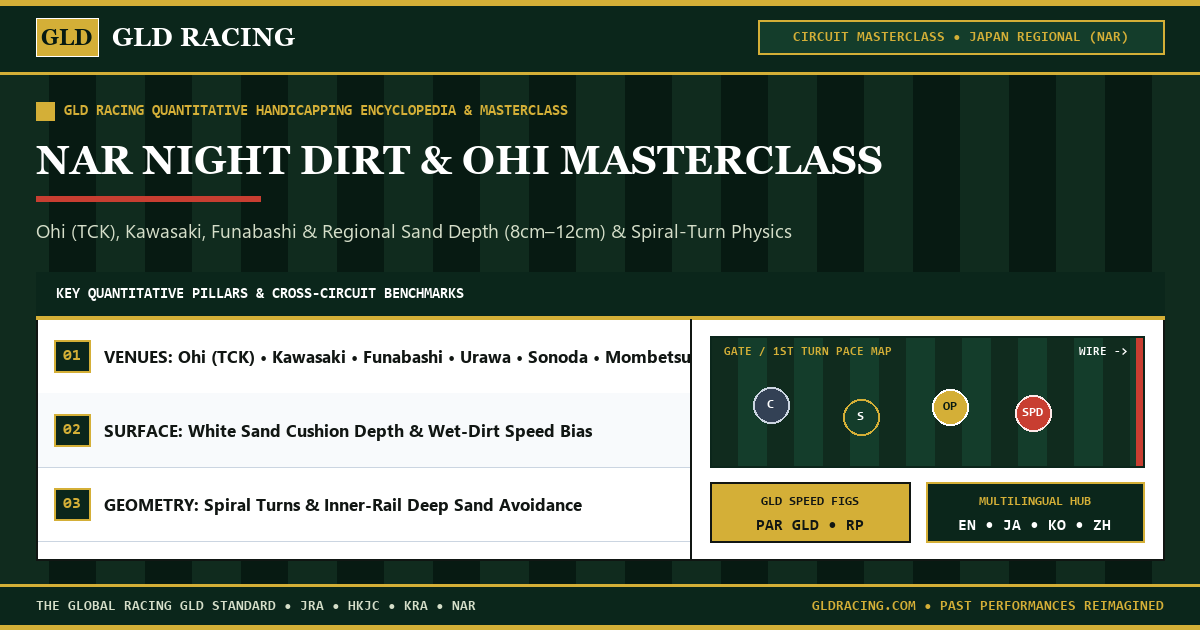
Japan's National Association of Racing (NAR / 地方競馬) operates year-round weekday and floodlit night racing ("Twinkle Race") across regional dirt circuits—providing continuous international wagering liquidity alongside weekend JRA central meetings. In our 865,435-start GLD Class Par benchmark repository, NAR regional dirt accounts for 386,781 verified starts (International Class Par Benchmarks), making it the single largest empirical dataset in Asian dirt racing.
Yet casual bettors who handicap NAR regional tracks using central JRA turf instincts get crushed. On tight NAR sand ovals—headlined by South Kanto's "Minami Kanto" quartet of Ohi Racecourse (Tokyo City Keiba / 大井競馬場), Kawasaki Racecourse, Funabashi Racecourse, and Urawa Racecourse, plus high-turnover regional circuits like Kochi, Mombetsu, Sonoda, and Kanazawa—sand depth (8cm to 12cm), rail sand replenishment ("Suna-hoju"), corner radius geometry, and JRA-to-NAR class transfers dictate race outcomes. This masterclass connects the Japan Racing Hub (`/ja`), Hong Kong Racing Hub (`/zh`), and Korea Racing Hub (`/ko`) with a quantitative blueprint for NAR night racing.
1. South Kanto ("Minami Kanto") & Regional NAR Track Architecture
While all active NAR dirt circuits (since姬路/Himeji and others follow standard sand ovals) run on deep sand, their turn directions, stretch lengths, and corner geometries differ dramatically (explore all 12 NAR venue profiles on `/japan/nar`):
- Ohi Racecourse — Tokyo City Keiba (TCK) (Right-Handed •
1600mOuter Oval •386mOuter Stretch /286mInner Stretch):
Located in Shinagawa, Tokyo, Ohi (大井 / 東京シティ競馬, home of international Dirt Grade 1 classics like the Tokyo Daishoten and Teio Sho won by champions such as USHBA TESORO and OMEGA PERFECTION) is the flagship right-handed dirt course in NAR. Crucially, Ohi utilizes two distinct stretch configurations:
- Outer Course (
386mhomestretch — Ohi 1200m, 1400m, 1800m, 2000m): Features one of the longest dirt stretches in Japan. Upgraded with bright Australian white quartz sand (10cmcushion depth), the Outer Course rewards high-stamina stalkers (OP) and sustained closers (LP) when the early pace heats up. - Inner Course (
286mhomestretch — Ohi 1500m, 1600m): Uses a tighter inner bend exiting the 3rd corner with a 100-meter shorter homestretch! Over Ohi 1600m, wide-drawn closers run out of ground; inside gates (Gates 1–4) post an11.6%strike rate vs6.1%for outside gates (/stats/track-bias). - Kawasaki Racecourse (Left-Handed •
1200mOval •300mStretch • Hairpin Corners):
Kawasaki is famous for having the sharpest, flattest hairpin turns in South Kanto. Because centrifugal force throws wide runners into the outer lanes exiting the 2nd and 4th turns, horses with elite Early Pace (EP) drawn in Brackets 1–3 that clear the rail into the first turn enjoy a massive geometric edge over Kawasaki 900m, 1400m, and 1500m.
- Funabashi Racecourse (Left-Handed •
1400mOuter Oval •308mStretch • Spiral Curves):
Funabashi is engineered with Spiral Curves ("Supairaru Kābu")—the turn radius tightens entering the bend and gradually widens exiting into the homestretch, paired with bank elevation. This allows outer-stalking horses (OP and C) to build momentum around the 3rd and 4th turns without losing velocity, making Funabashi 1200m and 1600m the fairest stalking track in South Kanto, especially since its renovation to deep Australian white sand.
- High-Bias Regional Tracks (Urawa, Kochi, Mombetsu, Sonoda):
- Urawa: Ultra-tight
1200moval with a220mhomestretch—pure early speed (SPD) and inside draws rule. - Kochi: Famous for having an intentionally ultra-deep inside rail sand strip (
12cm–15cmdeep along the inner 2 meters). Jockeys actively steer away from the inside rail into lanes 3–5 ("Soto-waku / Outer-lane bias"), making outer brackets (Brackets 6–8) superior on dry and standard going! - Mombetsu: Hokkaido's premier 2-year-old nursery track with sweeping
1600mturns and330mstretch, producing elite young dirt talent that later ships to Ohi and JRA.
2. Empirical NAR Class Par & Gate Bias Matrix (GLD Class Par)
Across 386,781 NAR starts, regional horses compete in an age-and-prize-money hierarchy ranging from Class C3 → C2 → C1 → B3 → B2 → B1 → A2 → A1 → Dirt Grade (DG / Jpn1). Below are the verified empirical benchmarks (view all 228 rows on `/stats/class-pars`):
| NAR Venue & Course | Distance | Official Class Tier | Empirical Par Time (GLD Class Par) | Par Velocity (m/s) | Benchmark Par GLD | Inside (1–4) Strike Rate | Outside (9+) Strike Rate | Key Sand & Corner Physics Profile |
|---|---|---|---|---|---|---|---|---|
| Ohi Dirt | 1200m Outer | Class A1 / Open | 1:11.85 | 16.70 m/s | 92 | 9.8% | 7.4% | 386m long stretch; high EP + sustained LP |
| Ohi Dirt | 1200m Outer | Class B2 / B3 | 1:13.10 | 16.42 m/s | 82 | 10.1% | 7.2% | Australian white sand; wet going (>=12%) favors SPD |
| Ohi Dirt | 1200m Outer | Class C1 | 1:13.85 | 16.25 m/s | 75 | 10.3% | 7.0% | Prime spot for JRA 1-Win transfers posting GLD 78+ |
| Ohi Dirt | 1200m Outer | Class C2 | 1:14.60 | 16.09 m/s | 69 | 10.4% | 6.9% | Fade public favorites running below GLD 67 |
| Ohi Dirt | 1600m Inner | Class B1 / B2 | 1:41.20 | 15.81 m/s | 85 | 11.6% | 6.1% | Short 286m Inner stretch; strong inside SPD/OP bias |
| Ohi Dirt | 2000m Outer | Dirt Grade 1 (G1) | 2:04.10 | 16.12 m/s | 115 | 9.2% | 8.1% | Tokyo Daishoten / Teio Sho championship stamina test |
| Kawasaki Dirt | 1400m | Class B2 / B3 | 1:29.40 | 15.66 m/s | 81 | 12.4% | 5.6% | Sharp left-handed hairpin turns; Gates 1–4 EP edge |
| Funabashi Dirt | 1600m | Class B1 / B2 | 1:41.65 | 15.74 m/s | 85 | 9.1% | 8.4% | Spiral curves + banked turns allow outer OP/C rallies |
| Urawa Dirt | 1400m | Class C1 | 1:29.85 | 15.58 m/s | 74 | 13.2% | 4.9% | 220m stretch; extreme front-running inside rail bias |
| Kochi Dirt | 1400m | Class B / Open | 1:30.40 | 15.49 m/s | 78 | 6.4% | 11.5% | Deep 14cm inside sand strip forces riders wide (Gates 6–12) |
3. Sand Depth Replenishment ("Suna-Hoju"), Moisture Compaction & Night Dew
To beat the public market on NAR cards, monitor three physical surface variables tracked on our Track Going & Moisture Impact (`/stats/going-impact`) hub:
- Australian White Sand Depth & Rail Replenishment:
Both Ohi and Funabashi now utilize imported washed Australian quartz sand (10cm base depth). Between meetings, track maintenance crews perform "Suna-hoju" (sand replenishment), often banking fresh loose sand along the inner 2–3 lanes. On Day 1 and Day 2 immediately following a sand replenishment under dry conditions (Good / 良), the inside rail is deep and tiring—creating a sudden golden highway for two-wide and three-wide stalkers (OP) drawn in Brackets 5–8!
- Moisture Compaction (
良Dry vs重 / 不良Wet/Sloppy):
Just like JRA dirt, NAR sand undergoes a dramatic velocity inversion when wet. On bone-dry sand (3%–6% moisture), raw 1200m times at Ohi slow by +0.9s and stamina closers (LP) get home. When typhoon rain or heavy precipitation saturates the track (重 Heavy or 不良 Sloppy), water binds the sand grains into a hard, sealed runway: raw times accelerate by -1.3s to -1.9s, and front-runners (SPD) wire card after card (How GLD Speed Figures Work).
- Twinkle Night Racing Temperature & Dew Shift:
During summer and autumn night meetings at Ohi, Kawasaki, and Funabashi, Races 1–4 are run in afternoon sun (drier, looser sand), while Races 8–12 are run under floodlights after coastal Tokyo Bay humidity settles onto the sand. This evening moisture tightens the surface by -0.3s to -0.5s, upgrading inside speed in the late pick-4 and triple legs.
4. Handicapping JRA-to-NAR Transfers & Inter-Track Shippers
One of the highest-volume betting angles in Japanese regional racing is evaluating JRA transfers ("Chuo-nyukyu")—horses dropping out of JRA Maiden or 1-Win classes into NAR Class C2, C1, or B3:
- The False JRA Transfer Favorite Trap: The public automatically bets any horse with "JRA" in its past performance lines down to
3/5odds—even if that horse finished 12th in JRA Maiden races with a dismal GLD Speed Figure of 58. Because Ohi Class C1 requires a Par GLD of 75 (and Class C2 requires Par GLD 69), a low-figure JRA castoff is a massive underlay to bet against (read our Par GLD vs. Race Power guide). - The Live JRA Transfer Monster: Conversely, when a JRA transfer posted a GLD Speed Figure of 74–80 in central dirt races—even while finishing 5th or 6th against tough JRA company—that runner towers over NAR Class C1/C2 fields (Race Power
RP~70–74) and can be keyed aggressively on top of Exacta and Trio tickets (GLD Line & Exotic Wagering Blueprint).
Frequently Asked Questions (FAQ)
Q1: What is the difference between Ohi Outer Course and Ohi Inner Course, and which distances use each?
At Ohi Racecourse (Tokyo City Keiba), the Outer Course has a sweeping 386m homestretch and is used for 1200m, 1400m, 1700m, 1800m, 2000m, and 2400m races—providing ample room for stalkers (OP) and closers (LP). The Inner Course turns off earlier at the 3rd corner into a short 286m homestretch and is used solely for 1500m and 1600m races. Always upgrade inside draws (Gates 1–4) and high Early Pace (EP) runners over Ohi 1500m and 1600m (/stats/track-bias).
Q2: Why do outer gates (Brackets 6–8) win at such a high rate at Kochi Racecourse?
Kochi Racecourse maintains an intentionally deep, heavy sand cushion (12cm to 15cm deep) along the inner 2–3 meters of the rail to protect horse soundness and drainage. Because running on the inside rail acts like running in beach sand, experienced Kochi jockeys steer into lanes 4 through 7 down the backstretch and homestretch, giving outer draws (Gates 6–12) an 11.5% strike rate vs 6.4% for inside gates.
Q3: How does Funabashi's Spiral Curve geometry affect pace handicapping compared to Kawasaki?
Kawasaki has flat, tight hairpin corners that severely penalize wide runners, making early gate speed (EP) dominant. Funabashi utilizes banked Spiral Curves whose radius widens exiting the turn, allowing horses with strong Mid-Race (MP) and Late Pace (LP) figures to sweep wide on the 3rd and 4th turns without losing momentum (First-Turn Pace Maps Guide).
Q4: How can I tell if a horse transferring from JRA to NAR (Ohi/Kawasaki/Funabashi) is a true standout or a public underlay?
Ignore the horse's raw JRA finishing position and look directly at its GLD Speed Figures on the racecard (try our Free Interactive Sample Racecard). Compare its last three GLD figures against today's NAR Par GLD (e.g., 69 for Ohi C2, 75 for Ohi C1, 82 for Ohi B2/B3) and Race Power (RP). If a JRA shipper ran 8th at Tokyo Dirt with a 77 GLD Figure, it holds a +8 point class edge over an Ohi C2 field; if it ran 8th with a 61 GLD Figure, fade it completely.
GLD Racing is an independent analytical service and is not affiliated with or endorsed by The Hong Kong Jockey Club (HKJC), Japan Racing Association (JRA), National Association of Racing (NAR), or Korea Racing Authority (KRA). All data and speed figures are provided for informational and analytical purposes. 18+ | Please Gamble Responsibly.