Final speed figures tell you how fast a horse ran in the past, but sectional pace physics dictate how today's race will actually be run. Two thoroughbreds can post the exact same 1:34.30 mile at Tokyo Racecourse or the exact same 1:09.03 sprint at Sha Tin Racecourse through diametrically opposed physiological pathways. One runner may blast the opening 400 meters in 22.90s and hang on desperately as lactic acid floods its muscles, while another relaxes five lengths off the rail and unleashes a blistering final 600 meters to arrive at the finish wire at the identical millisecond.
If you do not quantify how early velocity expenditure (EP) interacts with closing acceleration (LP) and course turn geometry (Track Bias & Barrier Statistics), you are handicapping blind. This guide explains the mathematical architecture behind GLD Racing's First-Turn Pace Maps, EP / MP / LP sectional figures, Pace Differential (PD), and the four tactical running style designations (SPD, OP, PCK, C) across Japan (`/ja`), Hong Kong (`/zh`), and South Korea (`/ko`).
1. The Three-Phase Sectional Physics Model: EP, MP, LP & PD
Thoroughbreds possess a finite anaerobic energy reserve—lasting roughly 35 to 42 seconds of maximal effort. Every fraction of a second spent burning anaerobic glycogen before the first turn is subtracted with compound interest in the final 400 meters. To model this energy curve across different international timing systems, GLD Racing divides every race into three standardized velocity segments:
- Early Pace (
EP): Measures gate-break acceleration and opening sectional velocity from the starting stalls to the first turn (or the opening 400m–600m call). HighEPidentifies horses capable of clearing the field and securing the inside rail. - Mid-Race Pace (
MP): Captures backstretch cruising velocity and turn transition efficiency. HighMPhighlights sustained stalkers that can absorb pressure without decelerating on spiral curves like Funabashi or sweeping turns like Kyoto. - Late Pace (
LP): Quantifies closing sprint velocity over the final 400m to 600m homestretch—normalizing Japan's Final 3 Furlongs (Agari 3F), Korea's Final 600m (G3F), and Hong Kong's final 400m transponder splits ($S_5$–$S_6$) against class par and daily surface going (Track Going & Moisture Impact). - Pace Differential (
PD = LP - EP): The net energy balance of the performance. A positivePD(e.g.,+6) indicates conserved early energy and explosive late acceleration; a strongly negativePD(e.g.,-8) indicates aggressive early gas usage followed by late deceleration.
2. Cross-Circuit Sectional Timing Architecture & GLD Class Par Track Bias Profiles
Each major Asian racing circuit records sectional splits differently and exhibits distinct geometric biases validated across our 865,435-start GLD Class Par dataset (explore full venue profiles on `/stats/track-bias`):
| Circuit Priority | Venue & Surface | Homestretch Length | Official Sectional Architecture | Inside (Gates 1–4) Strike Rate | Outside (Gates 9+) Strike Rate | Dominant Pace & Sectional Profile (GLD Class Par) |
|---|---|---|---|---|---|---|
| 1. JRA Central | Tokyo Turf | 525.9m (2.0m uphill) | Opening 3F + 200m Furlong Splits + Final 3F (Agari 3F) | 8.4% | 7.9% | Balanced galloping stretch; rewards top LP (Agari 3F <= 33.3s) |
| 1. JRA Central | Nakayama Turf | 310.0m (2.2m steep rise) | Opening 3F + Tight Corner Splits + Final 3F | 11.8% | 5.4% | Short stretch + tight turns heavily reward high-EP SPD & OP |
| 1. JRA Central | Hanshin Turf | 473.6m (Outer) | Opening 3F + Outer Sweep + Final 3F | 8.7% | 8.1% | Outer loop favors sustained LP closers (EQUINOX, LIBERTY ISLAND) |
| 2. Hong Kong (HKJC) | Sha Tin Turf | 430.0m | Continuous 400m Transponder Splits ($S_1$ to $S_6$) | 11.2% (Course A) | 5.8% | Balanced on Course A; shifts toward EP on Course C / C+3 |
| 2. Hong Kong (HKJC) | Happy Valley Turf | 312.0m (Course C+3) | Continuous 400m Transponder Splits ($S_1$ to $S_6$) | 14.8% | 3.2% | Extreme inside rail & high-EP speed bias on Course C+3 |
| 3. South Korea (KRA) | Seoul Sand | 400.0m | Opening 200m (S1F) + 1C–4C + Final 600m (G3F) | 12.4% | 4.9% | Deep kickback favors Gates 1–4 S1F leaders (SPD) |
| 3. South Korea (KRA) | Busan Sand | 460.0m | Opening 200m (S1F) + Wide Sweep + Final 600m (G3F) | 9.6% | 7.4% | Long 460m stretch rewards balanced stalkers & top G3F closers |
| 4. NAR Regional Dirt | Ohi Dirt | 386.0m (Outer) | Opening 3F + Corner Splits + Final 3F (Agari 3F) | 8.6% | 10.2% | Mid-to-outside momentum avoids deep inner rail sand |
| 4. NAR Regional Dirt | Kawasaki Dirt | 300.0m | Opening 3F + Hairpin Corner Splits + Final 3F | 12.6% | 5.1% | Sharp left-handed hairpin turns demand high EP rail position |
| 4. NAR Regional Dirt | Funabashi Dirt | 308.0m | Opening 3F + Banked Spiral Curve + Final 3F | 9.3% | 8.1% | Banked spiral turns allow mid-draw OP stalkers to carry speed |
3. Decoding the Four Tactical Running Styles: SPD, OP, PCK, and C
On every GLD Racing card (try the Free Sample Racecard Preview), each runner is assigned one of four tactical running style designations based on its historical first-call positioning and normalized EP index:
SPD(Speed / Pacesetter): Need-the-lead front-runners that break sharply and contest the early lead in the top 15% of the field'sEPdistribution.SPDhorses thrive when isolated on the front end or when competing on tighter ovals (Happy Valley, Nakayama, Seoul, Kawasaki) and moisture-compacted wet sand (/stats/going-impact).OP(Off-Pace / Tactical Stalker): Versatile contenders that settle 1.5 to 3.5 lengths behind the pacesetter in the "garden spot" (2nd to 5th position). Elite champions such asROMANTIC WARRIOR,KA YING RISING, andEQUINOXfrequently operate as high-efficiencyOPstalkers—staying out of suicidal early speed duels while getting first run on the deep closers turning for home.PCK(Mid-Pack Runner): Horses that settle in the middle third of the field (4 to 7 lengths off the lead).PCKrunners require clean trip lanes and an honest opening pace (PD >= +2) to bridge the gap in the stretch.C(Closer / Late Runner): Deep stretch sprinters (such asDO DEUCEor topG3Fsand closers at Busan) that drop 7+ lengths behind the early pace to conserve 100% of their anaerobic kick for the final 600 meters. Closers possess the highestLPand positivePDfigures on the card, but are highly vulnerable to slow-pace bias traps on tight tracks.
4. Reading the First-Turn Pace Map: Three Profitable Race Geometries
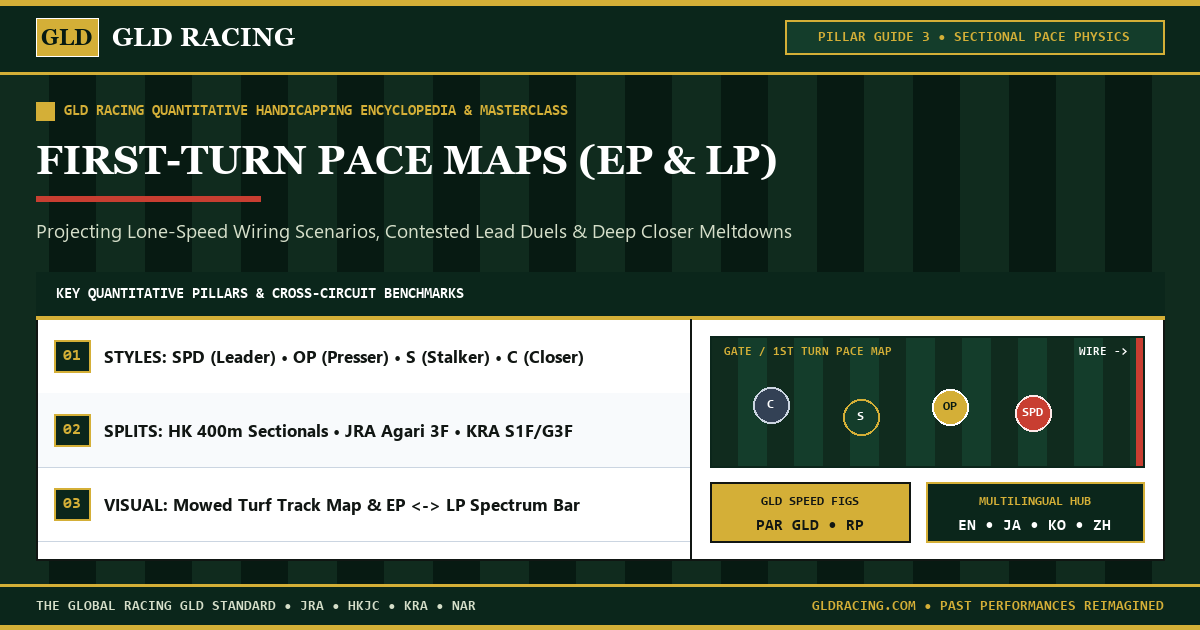
At the top of every race on GLD Racing, the First-Turn Pace Map plots every runner horizontally from left (backmarkers C) to right (front-runners SPD) based on projected first-turn position and barrier draw. Scanning this visual map reveals three high-expectation wagering setups:
Setup 1: Uncontested Lone Speed (SPD Isolation)
When a single SPD runner is plotted far to the right of the Pace Map—separated by 3.5 or more projected lengths from the nearest OP stalker—that horse controls the geometry of the race. Able to ration its opening EP energy without pressure, a lone SPD leader retains enough anaerobic reserve to kick clear in the homestretch.
- Best Tracks for Lone Speed: Happy Valley Course C & C+3, Sha Tin All-Weather Track (AWT), Seoul Sand (especially when sand moisture is
>= 12%), Nakayama, and Kawasaki.
Setup 2: The Contested Speed Duel & Pace Meltdown (4+ SPD Cluster)
When four or more SPD runners are jammed together at the far right of the Pace Map—particularly when two of those speed horses are drawn in wide barriers (Gates 9–14) and must burn extra EP gas just to cross over before the first turn—a Pace Meltdown is imminent.
- The dueling leaders force sub-par opening splits (e.g., an opening 800m at Sha Tin 1600m run 1.1 seconds faster than Empirical Class Par Benchmarks), exhausting their glycogen reserves before the 300-meter pole.
- How to Bet a Pace Meltdown: Fade the vulnerable low-
LPfront-runners and key the top Late Pace (LP) stalkers (OP) and closers (C) in Quinella, Exacta, and Trio pools, particularly on long homestretches like Tokyo (525.9m), Hanshin (473.6m), Sha Tin (430m), Busan (460m), and Ohi (386m).
Setup 3: Equipment-Triggered Pace Shifts (B1, BO, PC-, B-)
Always cross-reference the Pace Map against today's Equipment Changes (full equipment directory on `/guides`):
- First-Time Blinkers (
B1): Applying blinkers for the first time narrows a horse's peripheral vision and historically adds+3 to +5points of Early Pace (EP), frequently transforming a mid-packPCKrunner into an aggressiveOPorSPDfactor. - Blinker Removal (
B-) on a Distance Stretch-Out: Removing blinkers when a runner stretches out from 1200m to 1600m helps an overly keen horse relax early, loweringEPand boosting closingLP.
Frequently Asked Questions (FAQ)
Q1: How does GLD Racing normalize Japan's Agari 3F, Korea's G3F, and Hong Kong's 400m splits into Late Pace (LP)?
Raw closing sectionals cannot be compared without context: a 33.4s Final 3F (Agari 3F) on firm turf at Tokyo is common, whereas a 36.8s Final 3F on deep dry sand at Ohi or Seoul can be a monster closing effort. Our Late Pace (LP) figure normalizes the horse's final sectional velocity against the empirical closing par for that exact venue, distance, surface, and daily going variant (/stats/going-impact).
Q2: Which is more important—a high Early Pace (EP) figure or a high Late Pace (LP) figure?
Neither is universally superior; their value depends entirely on course geometry and today's Pace Map. On tight-turning tracks like Happy Valley, Kawasaki, or wet Seoul Sand, high EP combined with an inside barrier (Gates 1–4) dominates (/stats/track-bias). On expansive tracks with long homestretches like Tokyo, Sha Tin, or Busan—especially when 3+ SPD horses duel up front—high LP and positive PD are decisive.
Q3: What does a negative Pace Differential (PD) mean on a runner's past performance line?
Since $ ext{PD} = ext{LP} - ext{EP}$, a negative PD means the runner expended more velocity relative to par in the opening phase of the race than in the closing phase. While extreme negative PD (-10 or worse) often signals a horse that tired late or ran beyond its Offspring Winning Distance (OWD), a mild negative PD (-2 to -4) on a high-EP SPD horse can still wire the field if unchallenged on the lead.
Q4: How do I translate the First-Turn Pace Map into profitable Exacta and Trio wagers?
Use the Pace Map to separate structural pace winners from pace victims. When you spot a Lone Speed (SPD) advantage on an inside-biased rail, key that runner on top in Exacta tickets. When you spot a 4-horse speed duel meltdown, anchor the highest-LP closer (C) or stalker (OP) trading above its GLD Line in Quinella and Trio tickets (read the full Exotic Wagering Blueprint).
GLD Racing is an independent analytical service and is not affiliated with or endorsed by The Hong Kong Jockey Club (HKJC), Japan Racing Association (JRA), National Association of Racing (NAR), or Korea Racing Authority (KRA). All data and speed figures are provided for informational and analytical purposes. 18+ | Please Gamble Responsibly.